

The Visit Nobody Else Sees
A kitchen table forty minutes from the clinic
Picture a community health worker (CHW), call her Denise, three months out of certification and sitting at a kitchen table in a rural county forty minutes from the nearest clinic. Her client is a 62-year-old man with type 2 diabetes and high blood pressure, and he tells her he quit his metformin back in the spring. It upset his stomach, he says, and anyway he feels fine. Denise remembers the motivational interviewing unit from her course. She knows she's supposed to ask open questions, reflect what she hears, and let him talk his way toward his own reason to change. What comes out instead is a short speech about kidney damage, and he goes quiet the way people do when they've heard it all before.
What the record shows afterward
The visit gets logged as completed, and maybe a note says the client was counseled on adherence. Nobody watched the conversation or scored it, and Denise's supervisor is an hour away with a dozen other workers to support. She'll have some version of that same conversation hundreds of times this year. For most of them, she'll be figuring it out alone.
Knowing the Steps Isn't the Same as Using Them
A growing workforce with short training
The U.S. Bureau of Labor Statistics (BLS) projects that employment of CHWs will grow 11 percent from 2024 to 2034, much faster than the average for all occupations [1]. Most CHWs start with a high school diploma, and they typically complete a brief period of on-the-job training, with some states requiring certification [1]. Beyond that, training looks very different from one state or organization to the next. Communication skills like motivational interviewing may be introduced during a certification course or on the job. Once formal training ends, though, chances for repeated, structured practice can be hard to come by.
Rural work makes the gap wider
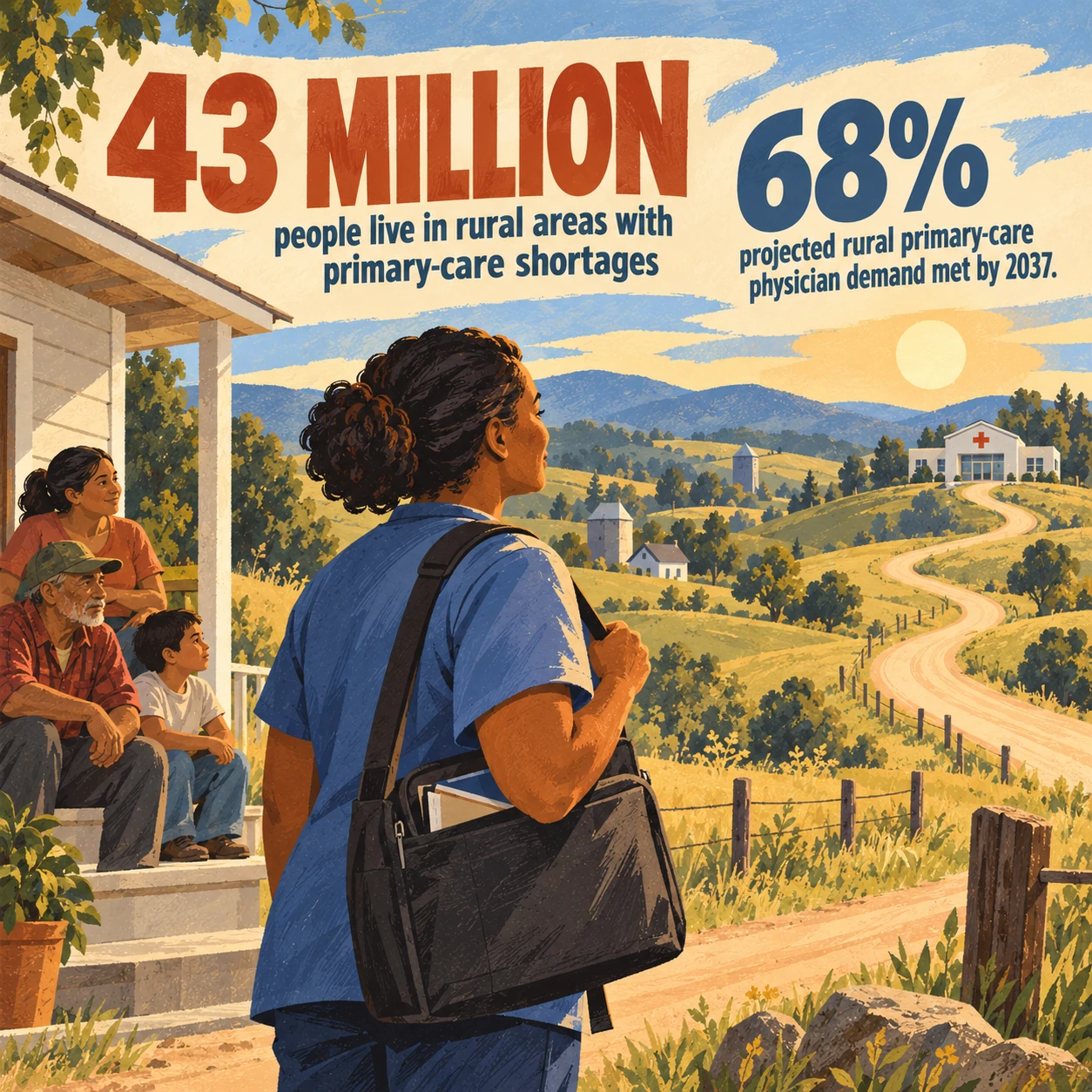
Outside cities, keeping up with training can take more effort. Forty-three million people live in rural areas with primary care shortages, and the Health Resources and Services Administration (HRSA) projects that by 2037, only 68 percent of demand for rural primary care physicians will be met [2]. CHWs are one of the ways rural communities try to close that gap. Because CHWs often work in homes, clinics, and other community settings, programs spread across large areas can struggle to offer frequent in-person skills practice [1,2].
Practice Is How the Skill Develops
Content builds knowledge, practice builds skill
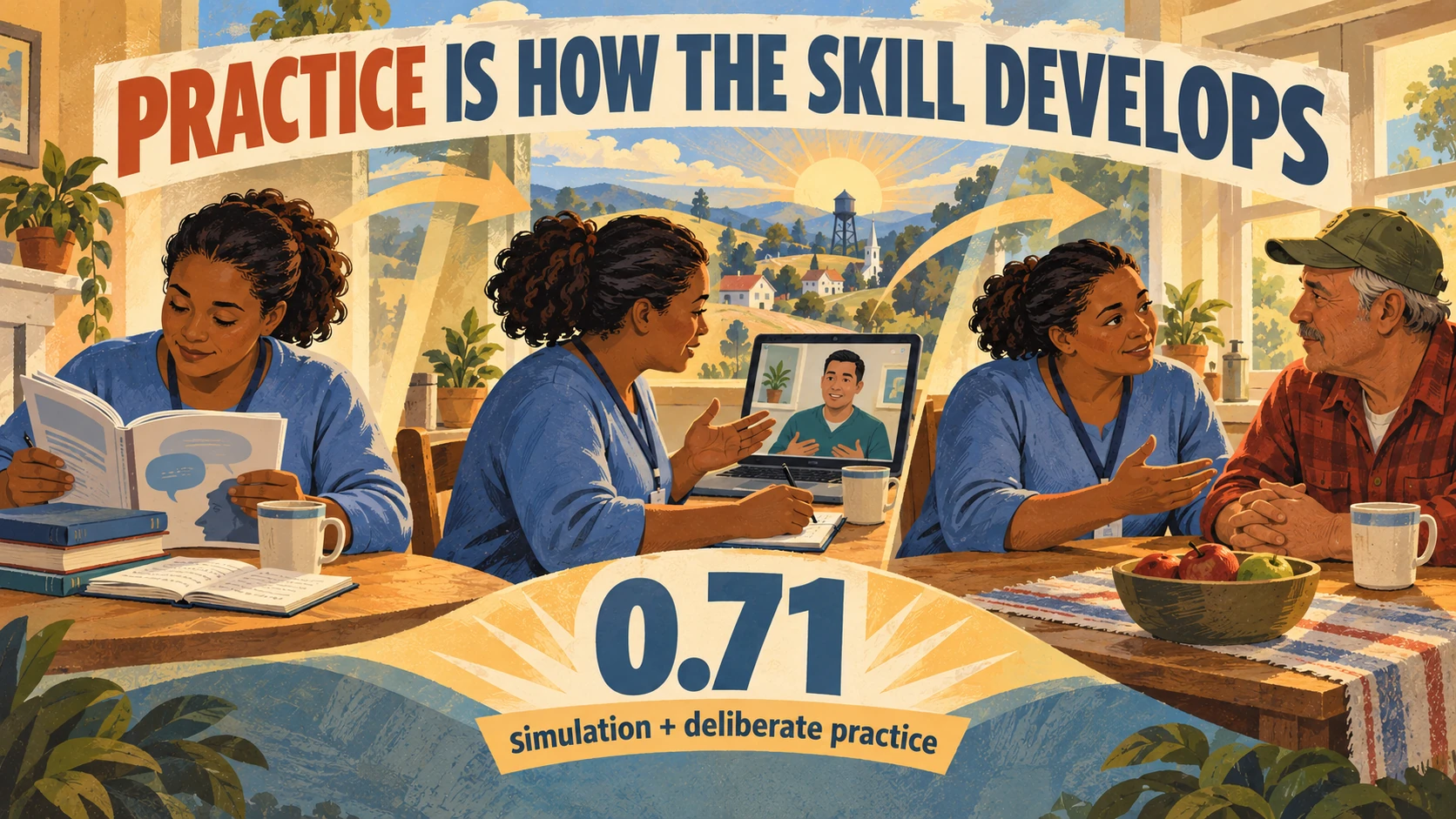
Anders Ericsson's 1993 research on expert performance described deliberate practice as effortful activity designed to improve performance, and he found that differences in skill were closely tied to how much of it people had done [3]. Medicine has tested the idea directly. A 2011 meta-analysis led by William McGaghie found an overall effect size of 0.71 in favor of simulation-based education with deliberate practice over traditional clinical education [4]. Motivational interviewing is exactly this kind of skill. Reading what a reflection is doesn't teach anyone to produce one while a client is pushing back.
Where virtual humans fit
Artificial intelligence (AI) virtual humans add the missing practice step. A CHW has a spoken conversation with a virtual client on a phone, tablet, or computer, whenever she has time. The client responds to what she actually says, pulling back when lectured and opening up when he hears his own words reflected. Afterward she gets scored feedback on specific skills and can try again that night or the next week. Programs build courses around the conversations their trainees find hardest, every trainee practices the same ones, and cohort results show instructors what to teach again.
Early Results From Palm Beach County
Moving the actor session online
Palm Beach County Medical Society Services runs a 27-hour CHW certification program that used to include three hours with a simulated patient actor. Working with Xuron as its partner, the program moved that practice online with an AI virtual patient named Carmen, who talks with trainees about taking medicines for diabetes, high blood pressure, and high cholesterol. Trainees can practice anytime and as many times as they want, and they get detailed feedback after each session [5]. The program launched recently, so the numbers below are preliminary internal data from Xuron and come from its first group of participants.
What learners felt and what their scores showed
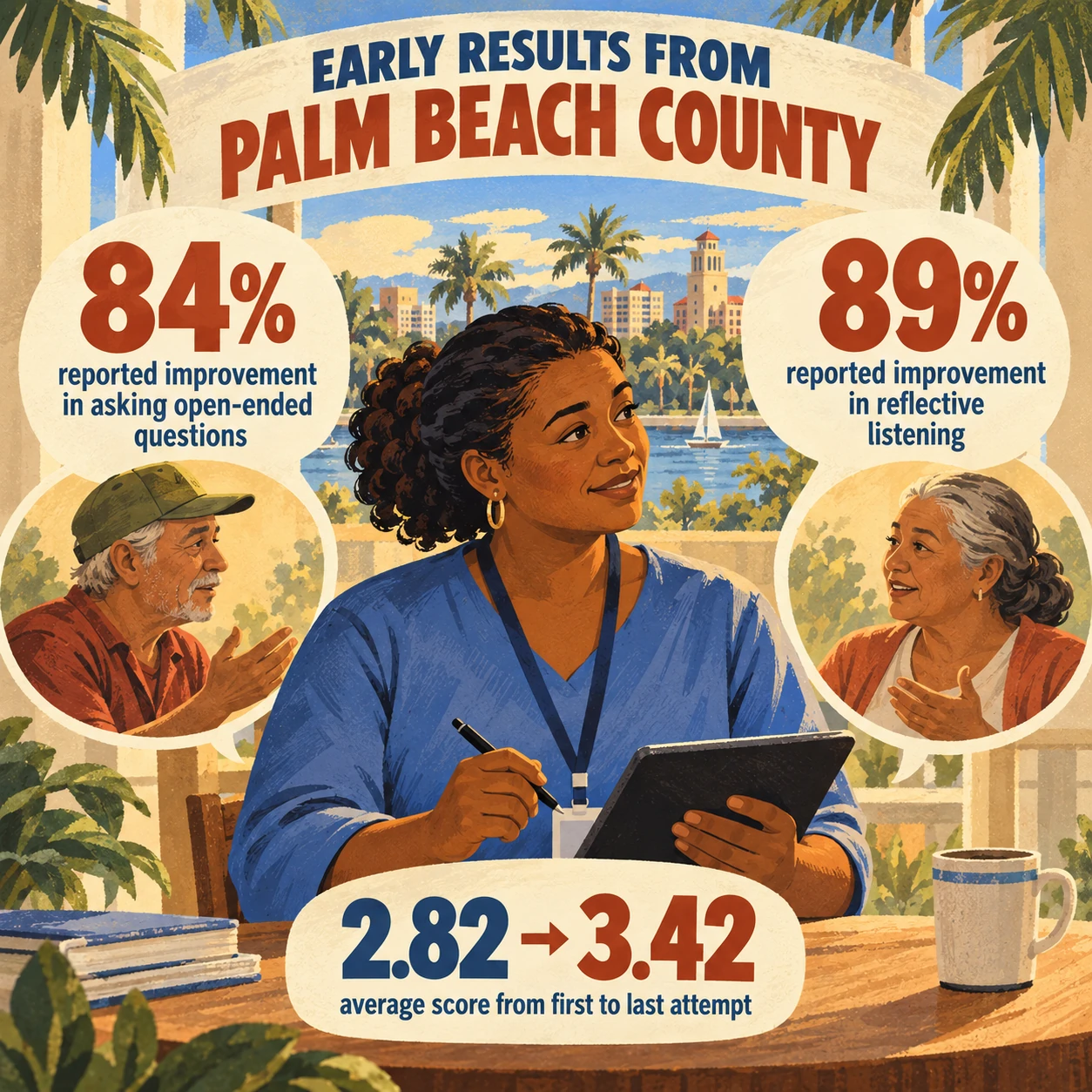
After their first completed simulation, 84% of learners reported improvement in asking open-ended questions and 89% in reflective listening. Another 89% reported improvement in recognizing a client's strengths, 84% in talking about change, and 79% rated the AI feedback as clear, specific, and constructive [5]. The scores from those same first sessions tell a more mixed story. Of the learners, 74% scored low (1 or 2 out of 5) on reflecting a patient's thoughts and feelings, 47% on exploring motivation to change, and 42% on asking open-ended questions [5]. Learners felt they'd picked up the skills, and many still struggled to use them in the moment. That gap is the whole reason for practice, and classroom role-play rarely makes it this visible to an instructor.
Scores rose with repeat practice
Twelve participants completed more than one session, and their average AI-generated score rose from 2.82 to 3.42 out of 5 between their first and last attempts [5]. In their comments, trainees described what changed for them in their own words. One wrote, "I learned to take my time as I ask question and to get to know the patient real feeling not just what they are saying." Another wrote, "The depth of the responses of the simulation prompted deeper thinking and realistic conversation and I found it helpful to my learning." A third put it simply: "This is a great tool. I need practice, practice, practice." Quotes appear with the trainees' original wording and spelling.
Reading these numbers carefully
These figures come from 19 grouped participant profiles, account checks are still pending, and the numbers may change [5]. The improvement figures are self-reported. The AI-generated scores haven't yet been checked against trained human raters, and the rise across repeat sessions could partly reflect familiarity with the case, so it doesn't prove the practice caused the gain. There's no data yet on changes in confidence or in how CHWs work with real clients [5].
What the Broader Evidence Shows
A small but encouraging body of research
A 2026 systematic review in the Journal of Medical Internet Research pulled together every study of generative AI virtual patients that met its criteria and found only 15, with 645 participants in total across nursing, medicine, pharmacy, radiography, and first-responder training [6]. The controlled studies generally reported better measured learning outcomes for virtual patients than for their comparison conditions [6]. Cost looks favorable too. In a United Kingdom trial of 396 medical students, AI practice cost about US$42 per student compared with about US$78 for actor-based training, although students reported somewhat larger gains in their communication skills after the actor sessions [7]. In a 2026 randomized trial of 51 health professions students and practitioners, people who practiced serious illness conversations with an AI virtual patient improved significantly more than people who spent the same time reading about the same framework, across all three skills measured [8].
What it doesn't show yet
The review's authors found stronger support for feasibility and acceptability than for learning gains or changes in real practice [6]. Samples were small, sessions were short, and almost none followed learners over time. None of the 15 studies in the review involved CHWs, which leaves an open question about whether this approach improves CHW skills or their real conversations with clients [6].
Where to Start
For a CHW program that wants to try this, the first step is picking one or two conversations trainees find hardest, often medication adherence or a client who isn't ready to change. Virtual patient practice can sit alongside the classroom teaching and role-play already in place, giving trainees more attempts than a class schedule allows. Track first-to-last scores, compare them with what instructors see, and keep access open after certification so rural graduates can keep practicing between visits. Controlled research hasn't yet shown whether this kind of practice changes what happens at the kitchen table. Programs that start now can help answer that by pairing simulation scores with instructor ratings and, over time, results from the field.
References
- U.S. Bureau of Labor Statistics. Community Health Workers. Occupational Outlook Handbook. https://www.bls.gov/ooh/community-and-social-service/community-health-workers.htm
- The Commonwealth Fund. The State of Rural Primary Care in the United States. Issue brief, November 2025. https://www.commonwealthfund.org/publications/issue-briefs/2025/nov/state-rural-primary-care-united-states
- Ericsson KA, Krampe RT, Tesch-Römer C. The role of deliberate practice in the acquisition of expert performance. Psychological Review. 1993;100(3):363–406. doi:10.1037/0033-295X.100.3.363
- McGaghie WC, Issenberg SB, Cohen ER, Barsuk JH, Wayne DB. Does simulation-based medical education with deliberate practice yield better results than traditional clinical education? A meta-analytic comparative review of the evidence. Academic Medicine. 2011;86(6):706–711. doi:10.1097/ACM.0b013e318217e119
- Xuron. Helping Patients Take Their Medicines: preliminary evaluation of an AI virtual patient component of the Palm Beach County Medical Society Services Community Health Worker certification program. Unpublished internal Xuron data, 2026.
- Jiang J, Ye MZ, Kwok TTO, Wong JYH. GenAI-supported virtual patients in health care education: systematic review. Journal of Medical Internet Research. 2026;28:e82756. doi:10.2196/82756
- Tyrrell EG, Sandhu SK, Berry K, Ghannam SF, Lewis SA, Crowfoot D, Sahota GS, Carson J, Wilson EE, Taggar J. Web-based AI-driven virtual patient simulator versus actor-based simulation for teaching consultation skills: multicenter randomized crossover study. JMIR Formative Research. 2025;9:e71667. doi:10.2196/71667
- Haut KG, Hasan M, Carroll T, Epstein RM, Sen T, Hoque E. The effects of generative AI virtual patient in serious illness communication skills: randomized controlled trial. JMIR Medical Education. 2026. Forthcoming/in press. doi:10.2196/93034