
What the Joint Commission tracks
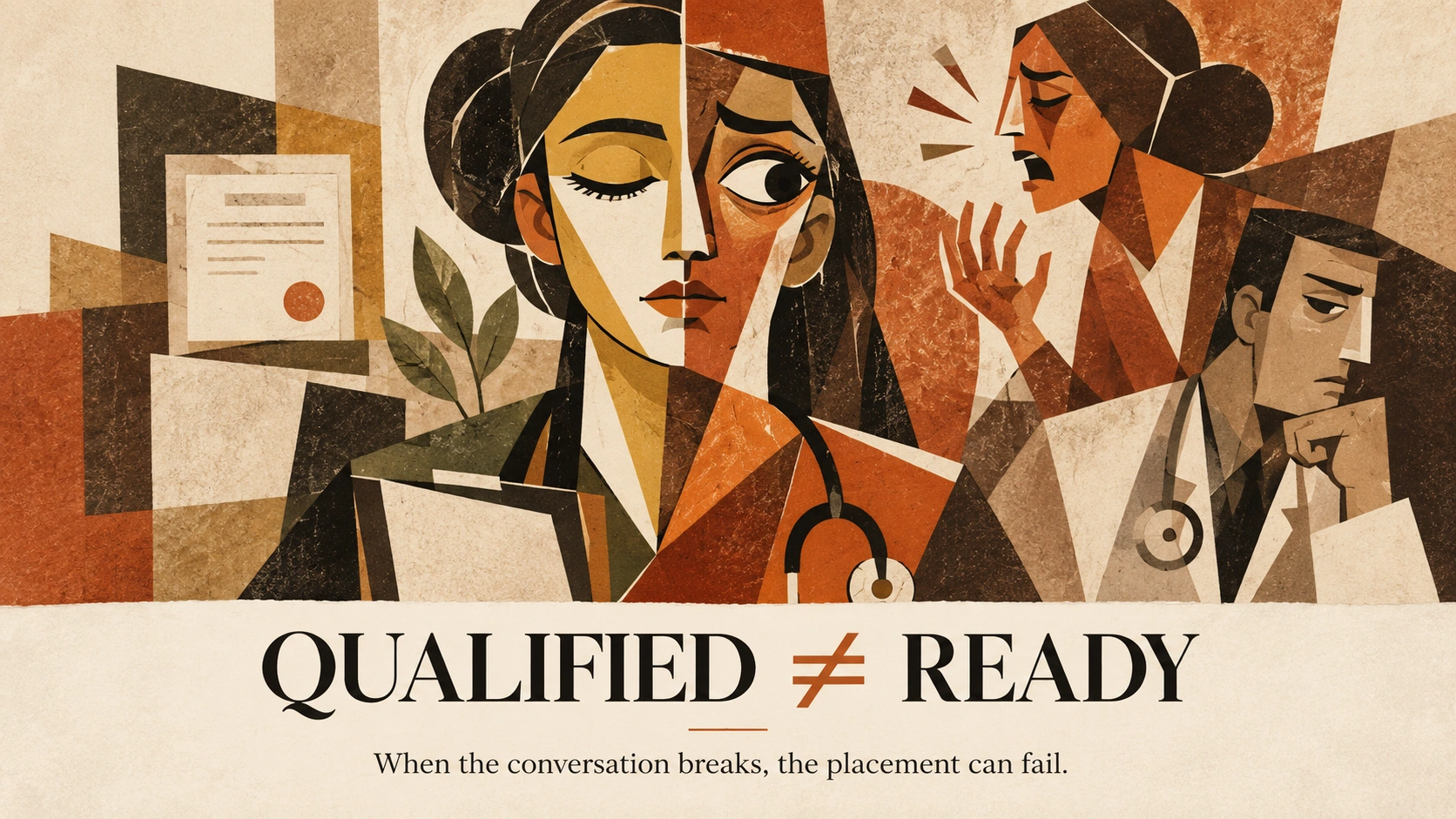
The Joint Commission asks certified healthcare staffing firms to report two things about the clinicians they place. One is whether the personnel file is complete, with credentials, competency documentation, and background checks all in order. The other is whether the client asked that the clinician not come back [1]. A firm can pass the first test and still fail the second.
What a Do Not Return means
That second measure is called a Do Not Return, or DNR. For travel placements, it means a client has asked that a clinician not finish the assignment, or not be sent back to that unit, facility, or health system. Certified firms track it on every applicable travel placement. The Joint Commission says DNRs can result from clinical skill, unprofessional behavior, or simply how the client perceives the clinician, and it warns that they can damage a firm's client relationships and reputation [2].
The costs add up quickly. An assignment that ends early loses its remaining billable hours, someone has to find and onboard a replacement, and the clinician may never be placed with that client again.
The Gap Between Qualified and Ready
A first week that goes wrong
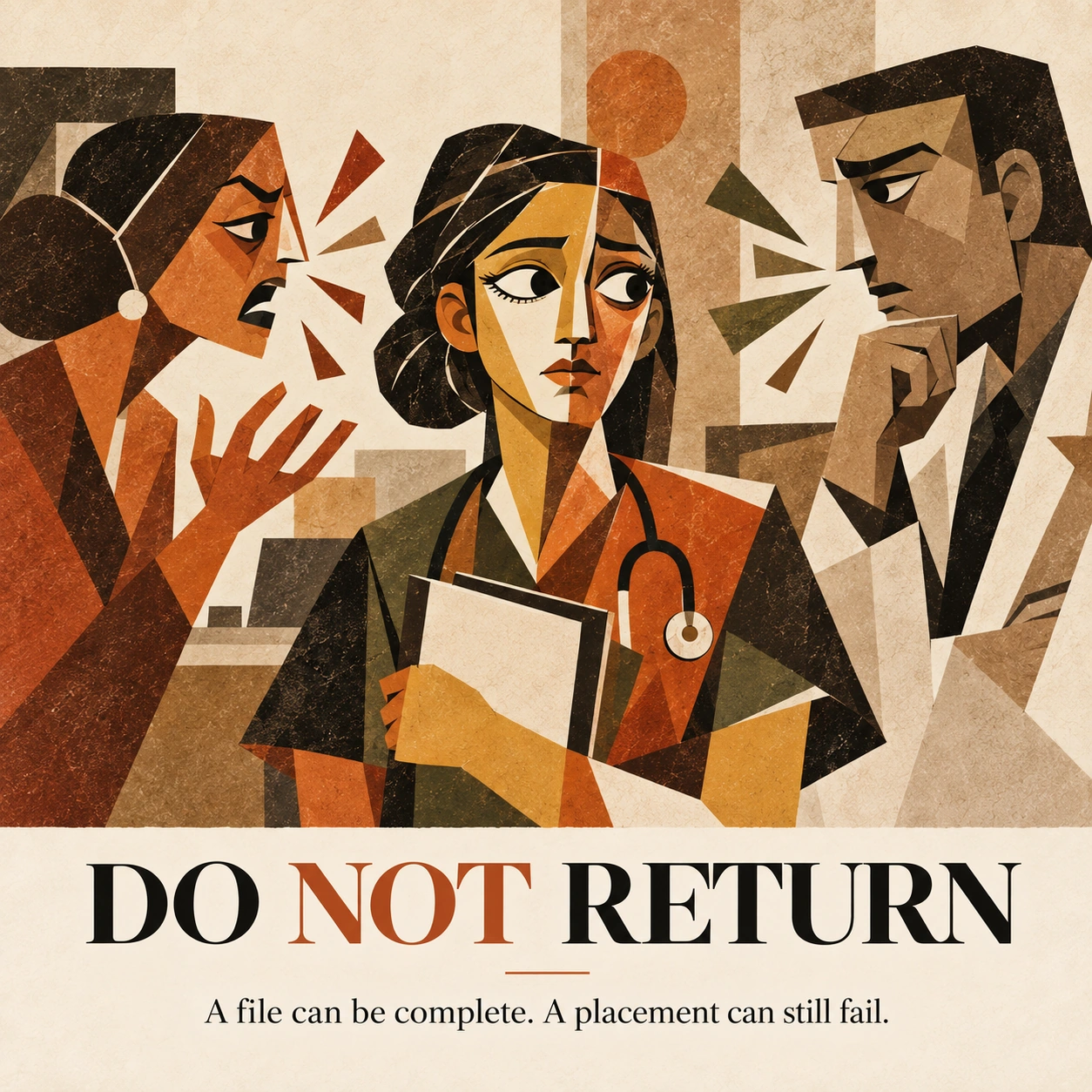
Picture a travel nurse named Dana. She has eight years of ICU experience, every credential is current, she passed her skills checklist, and she finished orientation on day one. On day four, a patient's daughter confronts her at the nurses' station, upset that the discharge instructions keep changing. Dana explains the policy correctly, but the daughter walks away feeling brushed off and files a complaint. Two days later, Dana calls a hospitalist she's never met about a worrying trend in a patient's vital signs. He waves it off, and she lets it drop. On Friday, the client calls the agency and asks that Dana not come back.
What her file couldn't show
Nothing in Dana's file was wrong. Credentialing showed she was eligible. Her competency assessment showed she had the skills and knowledge required to do the clinical work, and orientation covered the hospital's policies. None of it showed how she would handle an angry family member or push back on a physician she didn't know.
The Joint Commission draws the same distinction. It treats competency and performance as related but separate: competency asks whether someone has the skills, knowledge, and abilities for the job, while performance asks how well the person actually carries out those responsibilities [3].
Test it against your own records
Agency leaders can check this for themselves. Pull the last ten DNRs and read the reasons. Count how many trace back to a missing clinical skill, and how many trace back to a conversation that went badly. The Joint Commission lists client satisfaction records, complaints, incident reports, emails, phone notes, and staff evaluations as sources of DNR information [4]. Read them with care, since it also notes that some DNR requests can be subjective, biased, or unjustified [2].
Where AI Virtual Humans Come In
A flight simulator for hard conversations
Airline pilots already meet rigorous qualification requirements, and U.S. airlines still use full-flight simulators for training. Federal Part 121 rules require specified low-altitude windshear training to be conducted in an approved full-flight simulator [5,6]. AI virtual humans can give clinicians something similar for communication. If her agency had a course on upset family members, Dana could have practiced that kind of conversation before her first shift, answering a virtual daughter out loud, getting feedback, and trying again. A second course could have let her practice calling a doctor who dismisses her concern, then deciding what to say next.
New technology with early promise
This technology is new. When researchers pulled together the published studies on generative AI-supported virtual patients in healthcare education in 2026, they found only 15 studies [7]. In healthcare staffing, much of the visible AI investment has focused on recruiting and credentialing workflows rather than preparing clinicians after placement [8].
Clinicians and educators are also still getting used to the idea of talking with an AI-powered virtual patient. The early signals are promising. Across the 15 studies in the systematic review, learners generally found the approach usable and acceptable, while controlled studies reported improvements in areas including communication, history taking, and clinical decision-making [7]. A randomized controlled trial of 51 medical, nursing, and physician assistant learners and practicing clinicians found that participants who practiced serious illness conversations with a generative AI virtual patient improved more on measured communication skills than participants who spent the same amount of time reading instructional modules [9].
What it doesn't show yet
The evidence is still early. Many of the studies were small, interventions were often brief, and few followed learners over time. The systematic review found stronger evidence that people can use and accept these tools than evidence that the skills reliably transfer to real-world patient encounters over the long term [7]. These studies also measured learning outcomes, not healthcare staffing outcomes. Whether practicing with AI virtual humans lowers DNR rates, improves assignment completion, or increases the likelihood that a clinician is invited back remains unknown.

Practice Across the Whole Organization
How the programs work
The agency starts with its own records. It sorts DNRs, lost callbacks, and client complaints by reason and identifies the ones that come down to a conversation: an upset family member, a patient who refuses the plan, a clinician who needs to escalate a concern to an unfamiliar physician, or another interaction that repeatedly causes trouble. Each recurring situation becomes a practice course built around virtual humans. If ten communication problems keep showing up, the agency builds ten courses.
Everyone practices, more than once
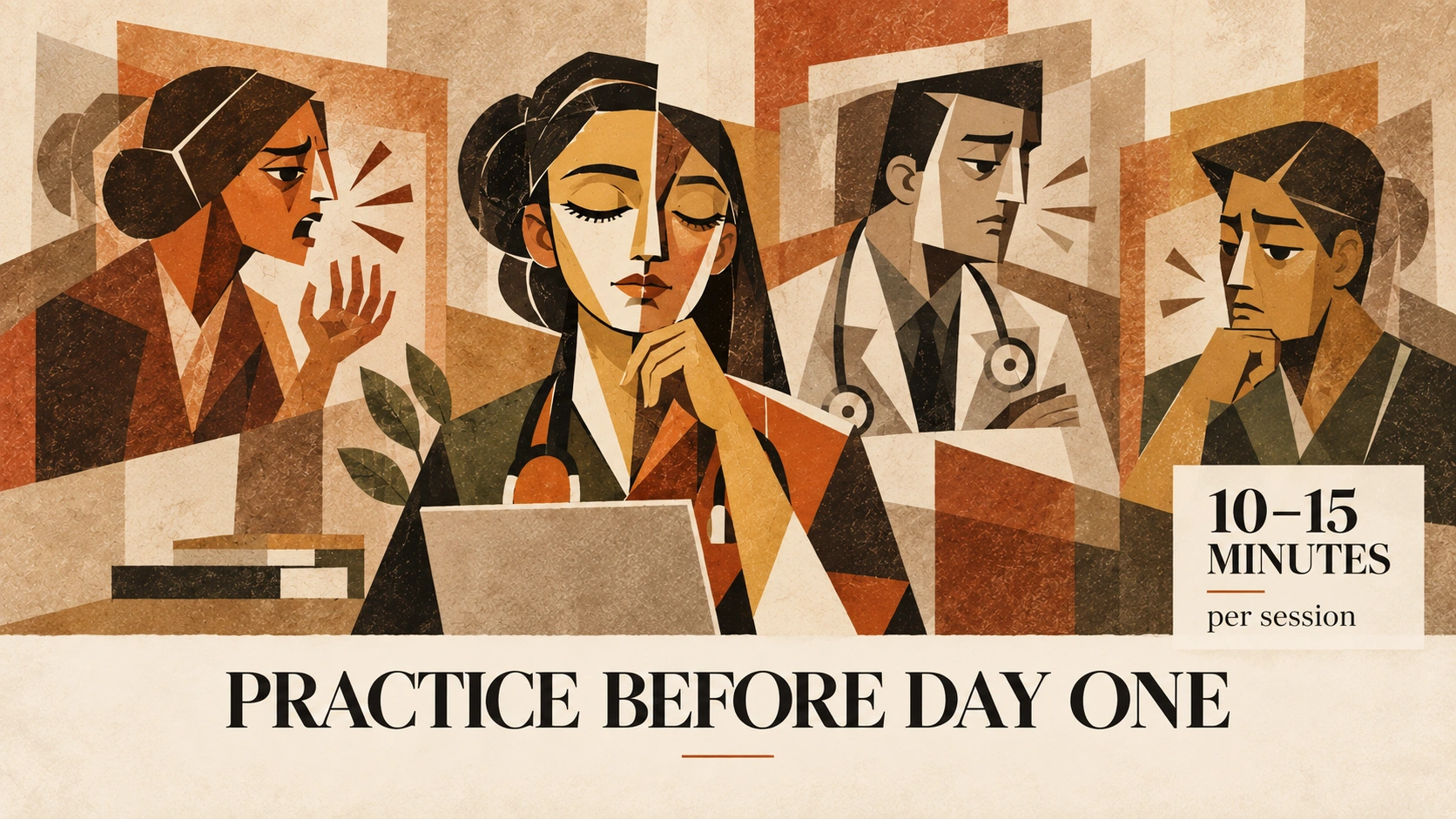
New hires go through the relevant courses before their first shift. Clinicians already on assignment go through them too, and everyone repeats them over time. Keeping each session to 10 or 15 minutes makes the practice easier to fit into the workday. Agencies also need to account for wage-and-hour requirements when training employees. Under the Fair Labor Standards Act, required job-related training generally counts as compensable time unless specific criteria are met for excluding the training from hours worked [10].
Keep the scores for coaching
Practice scores work best as coaching tools, not hiring filters. If an AI scoring tool is used to make or substantially assist employment decisions, laws such as New York City's rules governing automated employment decision tools may apply, including requirements related to bias audits and notices [11]. Used for coaching instead, the scores can help clinicians identify specific skills to improve while showing the agency which communication problems are appearing across its workforce.
A cycle that keeps going
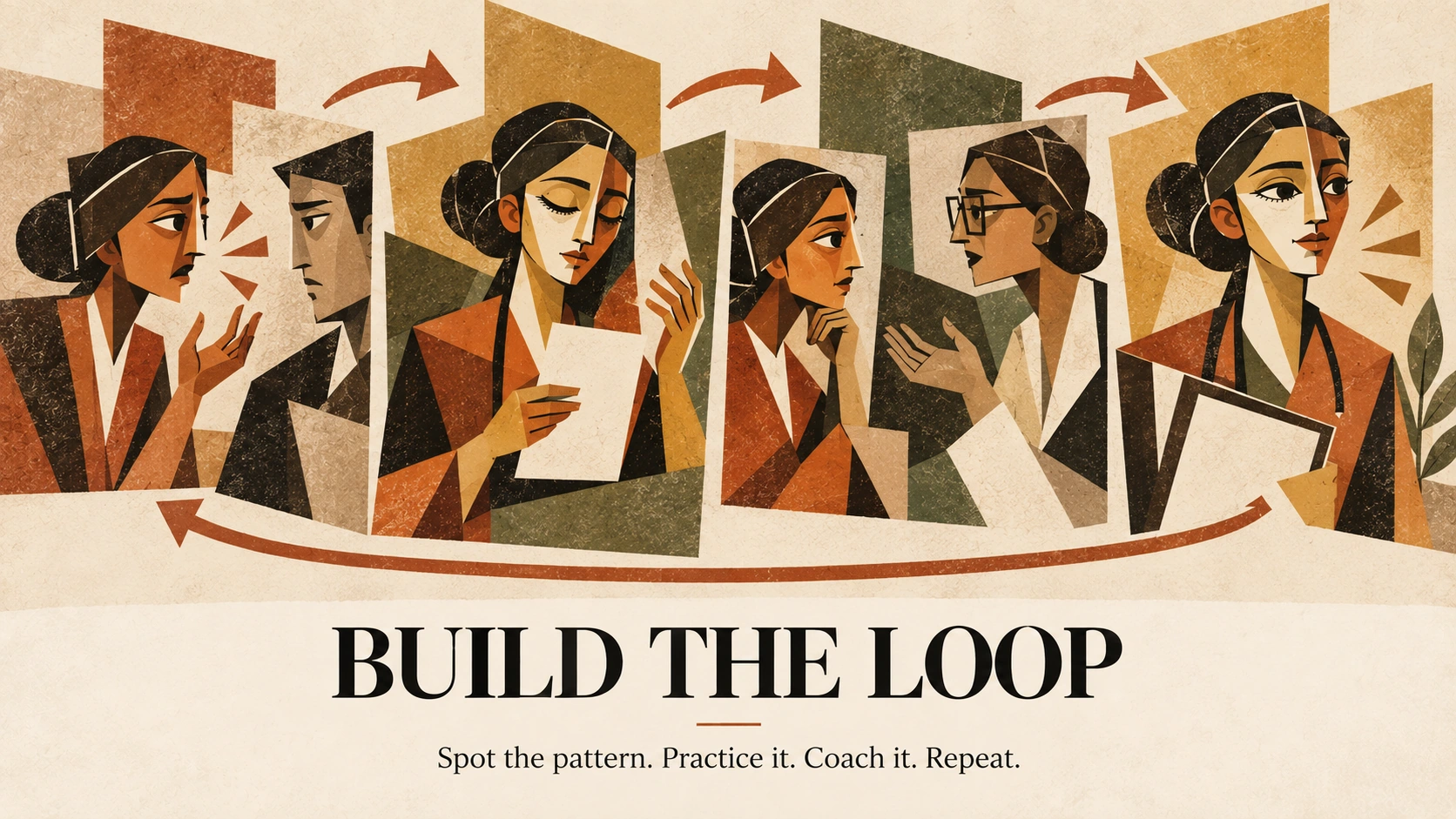
Practice data adds up across the whole workforce. When clinicians across many placements struggle with the same part of a course, the agency can see it. The agency compares those patterns with its DNR and callback data, identifies the next set of gaps, and builds new courses to address them. Then the cycle starts again.
Virtual humans have been used to identify communication gaps in healthcare training for years. In a 2015 study, postanesthesia care unit nurses managed a critical incident involving a virtual attending physician. Participants transferred only about 62% of critical patient information and achieved a similar score on interprofessional communication measures, demonstrating how simulation could expose specific educational needs [12]. Over time, the agency's course library comes to reflect the problems its clients actually report. The next nurse the agency sends to Dana's old unit has practiced a conversation like hers several times before arriving, and she keeps practicing after.
Where to Start
Credentials, competency checks, and orientation will always be the foundation of a safe placement. Virtual human practice covers a different part of readiness: how clinicians communicate when the situation becomes difficult, ambiguous, emotional, or confrontational.
For an agency that wants to test the idea, the first step doesn't require any new technology. Pull a year of DNR and callback records. Sort them by reason. Identify the three or four recurring situations in which communication appears to play an important role. Build practice courses around those situations, have clinicians complete them, and then track DNRs, assignment completion, callbacks, and other relevant client outcomes over the following months. Published research has not yet established whether AI virtual human practice reduces DNRs in healthcare staffing. That is the question an agency implementing this approach would actually be testing.
References
- The Joint Commission. Health Care Staffing Services (HCSS) measure set, v2026A. https://manual.jointcommission.org/releases/HCSS2026A/HealthCareStaffingServices.html
- The Joint Commission. HCSS-5: Do Not Return, v2026B. https://manual.jointcommission.org/releases/HCSS2026B/MIF0124.html
- The Joint Commission. Competency Assessment: Performance Evaluation. Standards FAQ. https://www.jointcommission.org/en-us/knowledge-library/support-center/standards-interpretation/standards-faqs/000001019
- The Joint Commission. Do Not Return data element, v2026B. https://manual.jointcommission.org/releases/HCSS2026B/DataElem0833.html
- Federal Aviation Administration. InFO 17017: Enhanced Pilot Training and Qualification for 14 CFR Part 121 Pilots. https://www.faa.gov/sites/faa.gov/files/pilots/training/air_carrier/enhanced_pilot_training/InFO17017.pdf
- 14 CFR § 121.409. Training courses using flight simulation training devices. Electronic Code of Federal Regulations. See also 14 CFR Part 121, Appendix E, Flight Training Requirements. https://www.ecfr.gov/current/title-14/chapter-I/subchapter-G/part-121/subpart-N/section-121.409 and https://www.ecfr.gov/current/title-14/chapter-I/subchapter-G/part-121/appendix-Appendix%20E%20to%20Part%20121
- Jiang C, Ye Y, Kwok YT, Wong GTC. Generative artificial intelligence-supported virtual patients in health care education: systematic review. J Med Internet Res. 2026;28:e82756. doi:10.2196/82756. https://www.jmir.org/2026/1/e82756
- Bullhorn. Healthcare staffing in 2026: How AI is helping firms reclaim recruiter productivity. https://www.bullhorn.com/blog/healthcare-staffing-in-2026/
- Haut KG, Hasan M, Carroll T, Epstein RM, Sen T, Hoque E. The effects of generative AI virtual patient in serious illness communication skills: randomized controlled trial. JMIR Medical Education. 2026. Forthcoming/in press. doi:10.2196/93034. https://preprints.jmir.org/preprint/93034
- U.S. Department of Labor, Wage and Hour Division. Fact Sheet #22: Hours Worked Under the Fair Labor Standards Act. https://www.dol.gov/agencies/whd/fact-sheets/22-flsa-hours-worked
- New York City Department of Consumer and Worker Protection. Automated Employment Decision Tools. https://www.nyc.gov/site/dca/about/automated-employment-decision-tools.page
- White C, Chuah J, Robb A, et al. Using a critical incident scenario with virtual humans to assess educational needs of nurses in a postanesthesia care unit. J Contin Educ Health Prof. 2015;35(3):158-165. doi:10.1002/chp.21302. https://onlinelibrary.wiley.com/doi/10.1002/chp.21302