
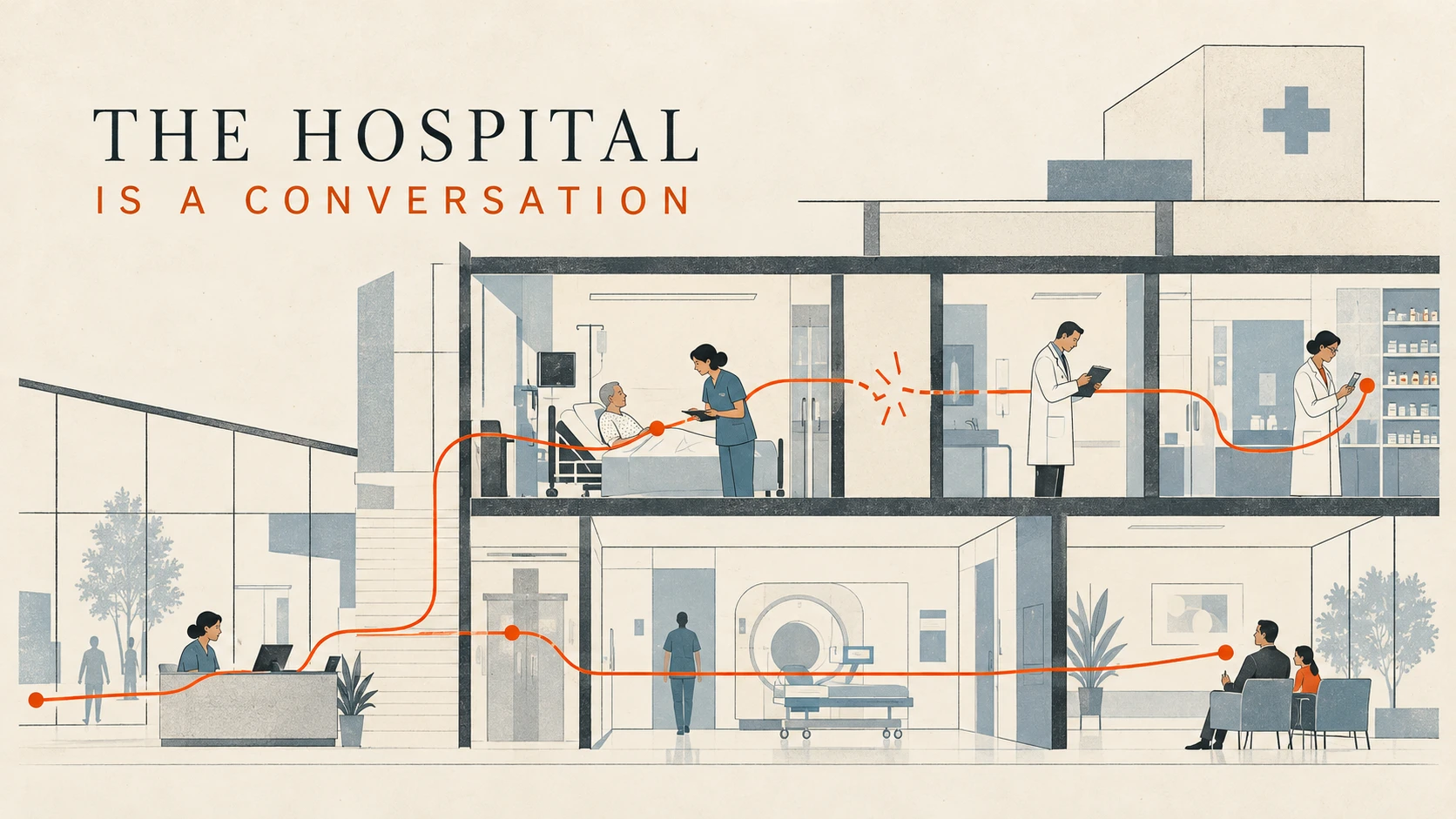
Communication failures in hospitals show up in malpractice claims, readmissions, workplace violence, and staff turnover. Many of them start in everyday conversations that nurses, physicians, nurse practitioners, physician assistants, pharmacists, and other health professionals rarely get to practice. Some of these failures come from gaps in skill, and others come from staffing and workflow problems that no training can fix. For the skill gaps, the research points to structure and repeated practice. Virtual human simulation, where clinicians talk out loud with a computer-generated patient or colleague and get feedback, is a new way to make that practice possible at scale. The early evidence is encouraging, and there's still a lot it hasn't shown.
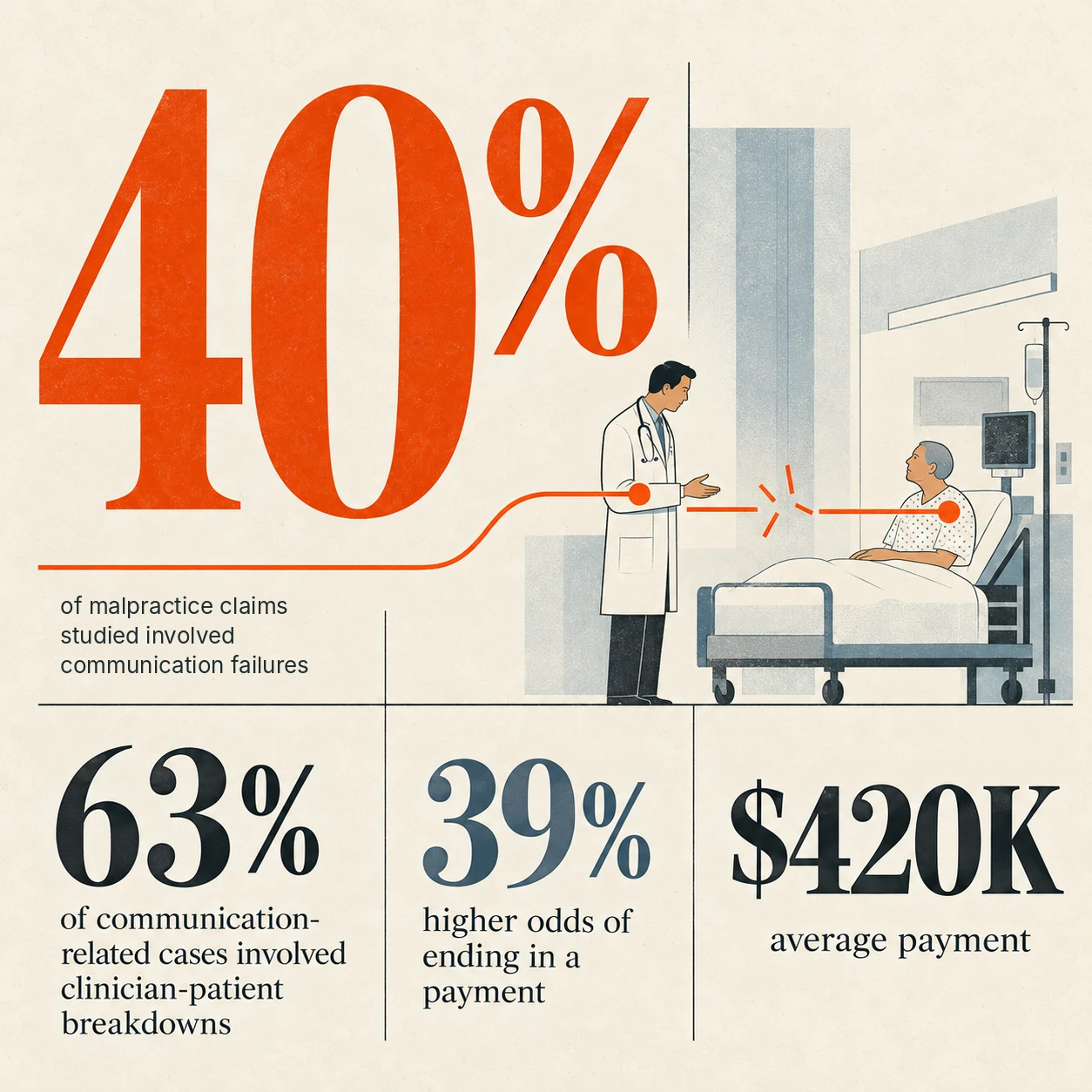
Over the last ten years, hospitals added patient portals, secure texting, and electronic handoff tools. Communication problems in malpractice cases still went up. Candello, the national malpractice data group run by CRICO, studied cases from 2014 through 2024 and found that communication failures played a part in 40% of malpractice claims, up from about 30% a decade earlier [1]. New tools haven't fixed the problem because most of these failures happen in conversations. They happen in a handoff at 7 a.m., a call to a doctor at 3 a.m., a pharmacist's explanation of a new blood thinner, or a discharge talk with a tired family. Hospitals usually teach these conversations once, and then expect staff to get them right every shift.
Why Communication Keeps Showing Up in the Data
What the malpractice numbers show
The share of cases tied to how clinicians talk with patients is growing. In Candello's data, breakdowns between clinicians and patients now appear in 63% of communication-related cases, up from 58% in 2015 [1]. These cases rarely start with a surprise. They usually start with how known risks, test results, and changing plans were explained to patients and families, or weren't explained at all [2]. Cases with a communication failure had 39% higher odds of ending in a payment, and the average payment was about $420,000 [1, 2]. They also cost more to defend, because they tend to be more complex and take longer to resolve [2]. None of this means better conversations would erase 40% of claims. It does mean communication is one of the most common threads running through the claims that hospitals do face.
Where it shows up on the floor
Malpractice is the slowest and rarest signal. Most communication problems show up sooner and in smaller ways. A handoff between residents skips the one detail the next team needed. A patient goes home unsure which pills to stop, because no one checked what the pharmacist's explanation actually meant to her. A family member's frustration with a physical therapist or a front desk clerk grows into shouting. The American Hospital Association estimates that violence cost hospitals and health systems more than $18 billion in 2023 [3]. Patients notice the everyday problems, too. The national HCAHPS survey asks a sample of recently discharged patients how well nurses and doctors listened and explained things, and how clear their discharge information was [4].
The cost when people leave
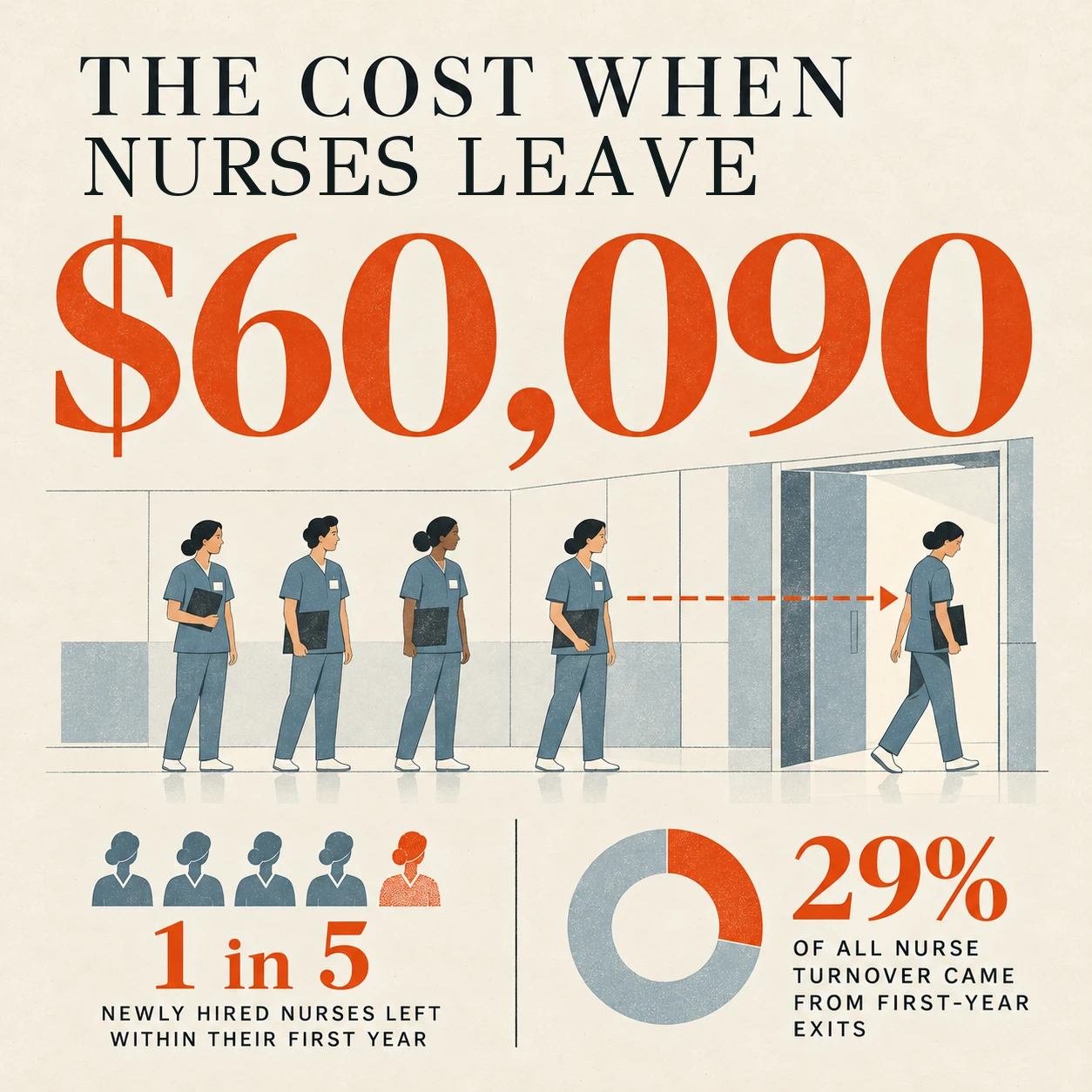
Communication also shapes who stays. The 2026 NSI report, based on a survey of 527 hospitals, put the average cost of losing one bedside nurse at $60,090 [5]. More than one in five newly hired nurses left within their first year, and those first-year exits made up 29% of all nurse turnover [5].
In a survey of 867 hospital nurses, those who felt safe speaking up on their units were more satisfied with their jobs and less likely to plan on leaving, and open communication on the unit helped explain that link [6]. New residents, nurse practitioners, physician assistants, and pharmacists face the same kind of pressure in their first months on the job. For all of them, some of the hardest parts of the work are conversations, not procedures.
A Hypothetical Night Shift
Picture a nurse named Maria, three months out of school and working nights on a medical floor. At 3 a.m., a patient's blood pressure keeps drifting down. She calls the covering physician, a first-year resident named Sam who is responsible for dozens of patients and sounds rushed. He tells her to recheck in an hour. Maria isn't sure how hard to push, so she lets it go, and Sam never asks what's worrying her. At 7 a.m., both of them give quick handoffs, and neither mentions the call. Each learned a standard format for these moments, and each passed every competency check. What neither of them got was practice.
Skill Problem or System Problem?
Before buying any training, hospital leaders need to sort out which failures come from skill and which come from the system. Training can't fix a nurse with too many patients. A 2026 review of the research found that each extra patient in a nurse's workload raised the odds of burnout by 8% and the odds of planning to leave by 9% [7]. Practice also won't help a resident who can't get an interpreter, a hospitalist whose inbox is overflowing, or a lab result that went to the wrong place. Those are staffing, tool, and workflow problems, and they need system fixes.
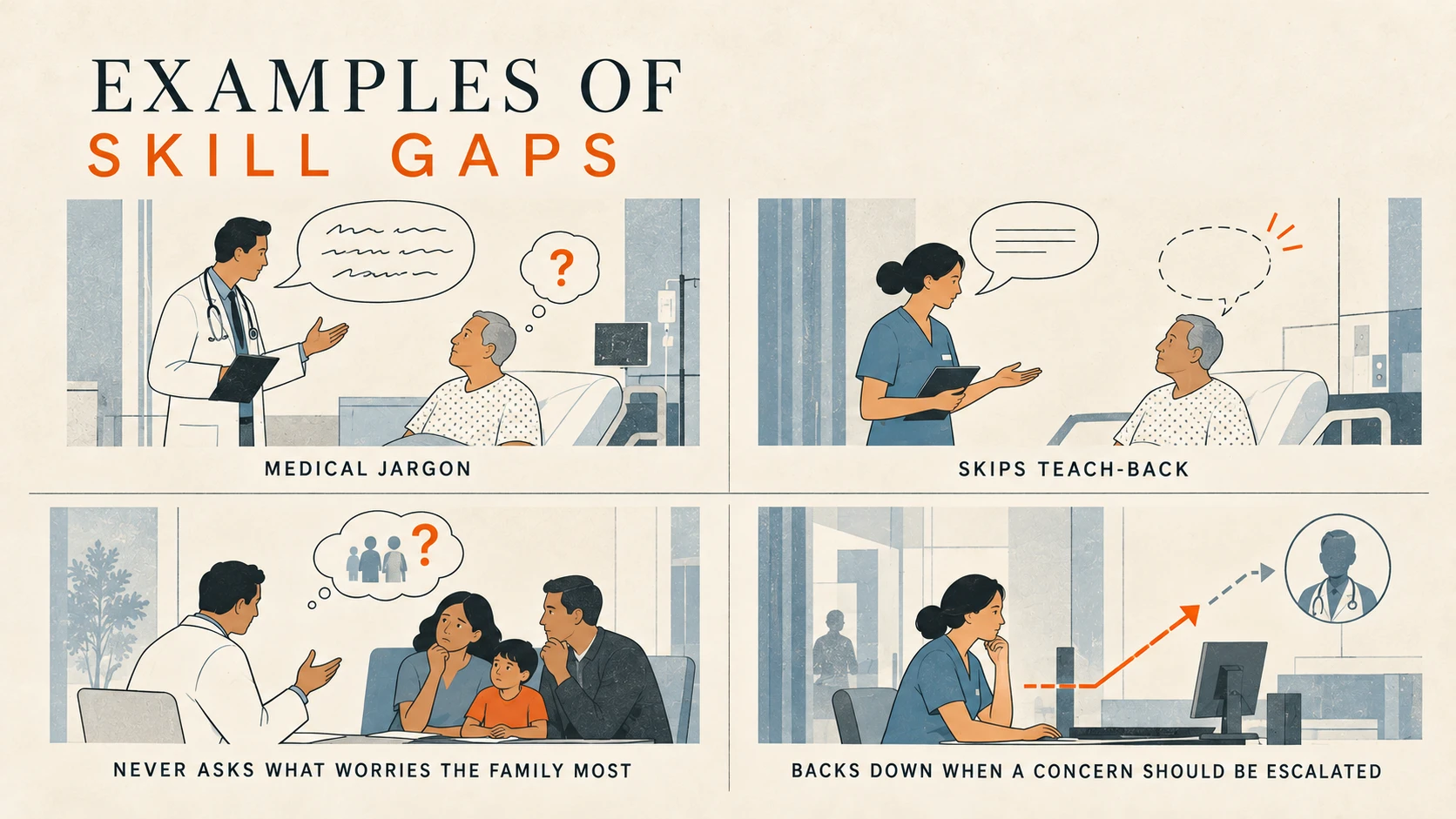
Other failures really are about skill. A physician uses medical jargon, a pharmacist skips teach-back (asking the patient to explain the plan in their own words), a nurse practitioner never asks a family what worries them most, or a nurse backs down when a concern should be escalated. Many failures sit somewhere in between. A handoff goes better with a standard format, and it also goes better when people have practiced using that format under pressure.
Leaders can test this with their own records. Pull the last 20 complaints and safety events that mention communication, across every role. For each one, ask whether the person had the time, tools, and information they needed. If they did, it's probably a skill gap. If they didn't, start with the system.
What the Evidence Says Works
Structure helps
Some of the strongest results come from adding structure to common conversations. In a 2014 study of resident physicians at nine children's hospitals, a handoff program called I-PASS cut medical errors by 23% and preventable adverse events by 30% across more than 10,000 admissions, and handoffs didn't take longer [8]. For discharge, a 2021 review of randomized trials found readmission rates of 9.1% in patients who received structured discharge communication, compared with 13.5% in patients who didn't [9]. Those discharge programs usually combined several pieces, such as medication review by a pharmacist and a written plan, so the drop can't be credited to conversation alone [9].
Training works when there's enough of it
Communication training helps, but a single session usually isn't enough. A 2025 review in Medical Care found that programs adding up to about 5.5 to 8 hours often improved patient experience scores, while a 45-minute session did not [10]. Gains from one-on-one coaching also faded when there were no follow-up sessions [10]. A second 2025 review of 55 communication training studies found that most programs improved how clinicians actually talked with patients, but only 8 of the 55 included any follow-up practice to keep those skills fresh [11]. Hospitals already know this pattern from CPR. Nobody learns it once and assumes it will hold for a whole career.
Why practice is hard to schedule
The usual gold standard for practice is a trained actor playing a patient, called a standardized patient. A 2024 review found that standardized patients beat peer role-play for building communication skills in most of the studies that compared the two [12]. But actors cost money and need to be scheduled, and every session pulls a nurse, doctor, or pharmacist away from patients. For a hospital with thousands of employees across dozens of roles, monthly practice with actors isn't realistic.
Where Virtual Humans Fit
Practice on demand
Virtual human simulation gives staff a way to practice hard conversations whenever they have a few minutes. A nurse, physician, pharmacist, or respiratory therapist talks out loud with a computer-generated patient, family member, or colleague on a phone, tablet, or computer. The virtual human answers in real time and responds to what the person actually says. Afterward, the learner gets scores and specific feedback on the conversation and can try again right away. Maria could have practiced calling a rushed doctor several times before her first night on her own. Sam could have practiced taking that call from a worried nurse.
What early studies show
This technology is new. A 2026 review in the Journal of Medical Internet Research found only 15 published studies of virtual patients powered by generative AI [13]. The early signals are encouraging. In a 2026 randomized trial, 51 medical, nursing, and physician assistant learners and clinicians who spent 30 minutes practicing serious illness conversations with an AI virtual patient improved more than a group that read about the topic, based on ratings from reviewers who didn't know which group each person was in [14]. In a trial with 80 nursing students, virtual practice led to large gains in empathy right away and moderate gains at follow-up, and the AI's scores agreed closely with scores from nurse educators [15].
A 2026 study of physician-patient communication compared AI virtual patients with human actors and found that both groups improved [16]. Learners who practiced with the virtual patient chose to do more practice sessions, and they said it was because they could practice anytime without feeling judged [16]. Cost may matter as well. A 2025 study of 396 students estimated direct costs of $42.22 per learner for AI-based practice and $77.87 for actor-based practice [17]. That estimate left out setup costs, and students who trained with actors reported somewhat bigger gains and were more satisfied [17].
What it doesn't show yet
The studies so far are small and short, and most took place in schools rather than hospitals [13]. None has shown yet that virtual practice lowers readmissions, malpractice claims, or staff turnover. In the actor comparison, AI practice led to better scores on what learners covered, while scores on the relationship side of the conversation were about the same [16]. The 2026 review also noted that virtual patients still have limits with nonverbal cues and emotional depth [13]. For now, the most sensible model is a mix. Virtual humans handle frequent practice, and human actors and coaches handle high-stakes assessment and the most emotional conversations.
Building a Hospital Program
Start with the conversations that matter most
Not every conversation needs the same kind of practice. Some happen thousands of times a month, like bedside updates, handoffs, medication counseling by pharmacists, discharge teaching by nurses and case managers, and patient education by physical and occupational therapists. A small improvement repeated that often can add up, and these conversations are a good fit for short, frequent virtual practice. Others are rare but serious, like informed consent with a surgeon, a serious illness talk with a hospitalist or nurse practitioner, telling a patient about a medical error, or calming someone who is close to becoming violent. Those may call for virtual practice plus time with an actor or coach. Each conversation also tends to have a different owner, from nursing and medical staff leaders to pharmacy, patient experience, risk management, and security. It helps to decide who owns each one before choosing tools.
Include nonclinical staff
Many tense moments start with registration clerks, billing staff, security officers, and transport teams. Research on these roles is thin. One 2026 study at a 216-bed children's hospital trained clinical and nonclinical staff together and saw improvement on five of eight targeted patient experience measures [18]. That study compared scores before and after the training rather than against a control group [18]. The AHA's 2026 issue brief on de-escalation also recommends ongoing, simulation-based training across roles, including front-desk staff [3].
Make it a cycle
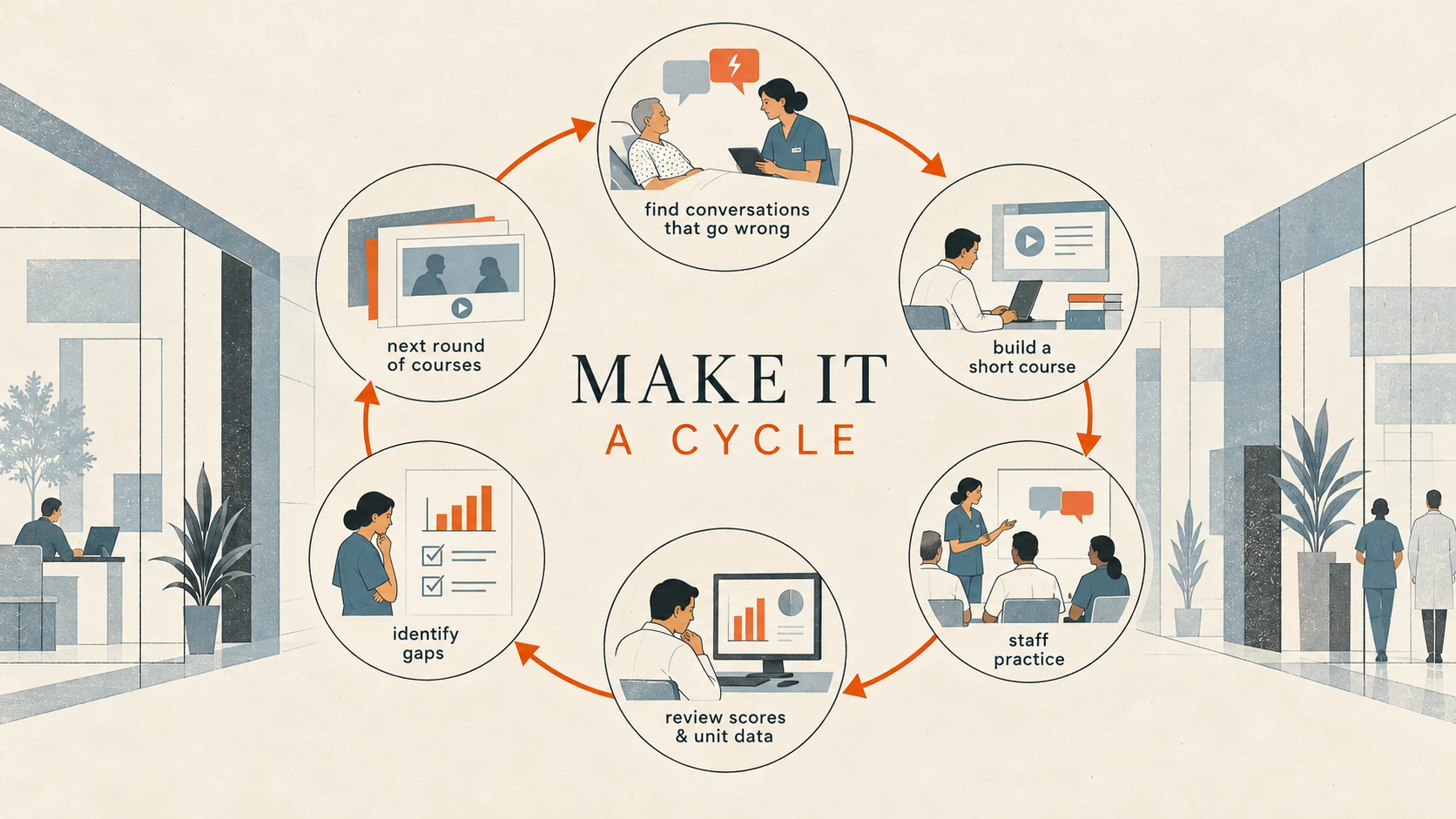
A one-time rollout repeats the problem it's trying to solve. A better approach works as a loop. The hospital finds the conversations that keep going wrong in its own complaints, safety events, and claims, then builds a short course for each one. Staff in those roles practice it and come back to it every month or quarter. Practice scores and unit data show what improved and where people still struggle, and those gaps become the next round of courses. Scores work best for coaching, not discipline. Before anyone relies on them, a sample should be checked against trained human raters. One nursing study found strong agreement between AI and human scores in its own system [15], but each tool has to be checked on its own.
Where to Start
Hospital leaders don't need new technology to begin. Pull a year of complaints, safety events, and claims that mention communication, and sort them into skill problems and system problems. From the skill side, pick the three conversations that come up most often. Onboarding is a natural place for a pilot, whether that's a new nurse residency, intern orientation, or the first months for new nurse practitioners, physician assistants, and pharmacists. First-year nurses leave at the highest rates, and new clinicians in every role face many of these conversations for the first time [5]. Measure observed skill first, then watch unit data like complaints, handoff quality, and patient experience scores over six to twelve months. No one has published hospital outcome data for this kind of practice yet, so the hospitals that start now will be among the first to see whether it changes results. The next time a new nurse on Maria's unit calls a new resident like Sam at 3 a.m., both of them could have already practiced that conversation a few times, and they could keep practicing after.
References
- CRICO. New Candello report reveals communication failures between providers and patients are rising. November 17, 2025. https://www.rmf.harvard.edu/News-and-Blog/Press-Releases-Home/Press-Releases/2025/November/2025BenchmarkingReport10yearlookbackComm
- Medical Professional Liability Association. Financial impact of medical miscommunication. Inside Medical Liability. Winter 2026. https://www.mplassociation.org/Web/Publications/Inside_Medical_Liability/Issues/2026/Winter/Financial_Impact_of_Medical_Miscommunication.aspx
- American Hospital Association. Reducing incivility and violence in healthcare settings: Maximizing the use of de-escalation techniques. Issue brief. September 30, 2026. https://www.aha.org/issue-brief/2026-09-30-issue-brief-reducing-incivility-and-violence-healthcare-settings-maximizing-use-de-escalation-techniques
- Centers for Medicare & Medicaid Services. HCAHPS: Patients' Perspectives of Care Survey. https://hcahpsonline.org
- NSI Nursing Solutions. 2026 NSI National Health Care Retention & RN Staffing Report. March 2026. https://www.nsinursingsolutions.com/documents/library/nsi_national_health_care_retention_report.pdf
- Psychological safety, communication openness, nurse job outcomes, and patient safety in hospital nurses. 2023. PMID: 37370217. https://pubmed.ncbi.nlm.nih.gov/37370217/
- The impact of nurse-to-patient ratios on nurses' burnout, job dissatisfaction, and intention to leave: A systematic review and meta-analysis. 2026. PMID: 41871130. https://pubmed.ncbi.nlm.nih.gov/41871130/
- Starmer AJ, Spector ND, Srivastava R, et al. Changes in medical errors after implementation of a handoff program. N Engl J Med. 2014;371:1803-1812. DOI: 10.1056/NEJMsa1405556. https://doi.org/10.1056/NEJMsa1405556
- Becker C, Zumbrunn S, Beck K, et al. Interventions to improve communication at hospital discharge and rates of readmission: A systematic review and meta-analysis. JAMA Netw Open. 2021;4(8):e2119346. DOI: 10.1001/jamanetworkopen.2021.19346. https://doi.org/10.1001/jamanetworkopen.2021.19346
- Improving patient experience with provider communication: Systematic review of interventions, implementation strategies, and their effectiveness. Medical Care. 2025;63(8):545-554. DOI: 10.1097/MLR.0000000000002158. https://doi.org/10.1097/MLR.0000000000002158
- Peimani M, et al. Training in communication skills for healthcare providers in chronic care: A systematic review. BMC Medical Education. 2025;25(1):1314. PMID: 41039423. https://pubmed.ncbi.nlm.nih.gov/41039423/
- Rutherford-Hemming T, Herrington A, Ngo T. The use of standardized patients to teach communication skills: A systematic review. Simulation in Healthcare. 2024;19(1S):S122-S128. DOI: 10.1097/SIH.0000000000000766. https://doi.org/10.1097/SIH.0000000000000766
- Jiang, Ye, Kwok, Wong. GenAI-supported virtual patients in health care education: Systematic review. Journal of Medical Internet Research. 2026;28:e82756. https://www.jmir.org/2026/1/e82756
- Haut, et al. Effects of a generative AI virtual patient on serious illness communication skills: Randomized controlled trial. JMIR Medical Education. 2026;12:e93034. DOI: 10.2196/93034. https://doi.org/10.2196/93034
- Chen PJ. AI-enhanced virtual reality simulation for nursing students' empathy: Automated scoring and inter-rater reliability in a randomised controlled study. Nurse Education Today. 2026;159:106968. PMID: 41500151. https://pubmed.ncbi.nlm.nih.gov/41500151/
- Sun, Zhou, Yang, et al. Application of AI-based virtual standardized patients in physician-patient communication training: A study based on the SEGUE framework. Frontiers in Public Health. 2026;14:1768518. PMID: 41988587. https://pubmed.ncbi.nlm.nih.gov/41988587/
- Web-based AI-driven virtual patient simulator versus actor-based simulation for teaching consultation skills: Multicenter randomized crossover study. JMIR Formative Research. 2025;9:e71667. DOI: 10.2196/71667. https://doi.org/10.2196/71667
- Back-to-basics hospital-wide training improves inpatient pediatric care experiences. Hospital Pediatrics. 2026. PMID: 41667073. https://pubmed.ncbi.nlm.nih.gov/41667073/