
The clinic with nobody down the hall
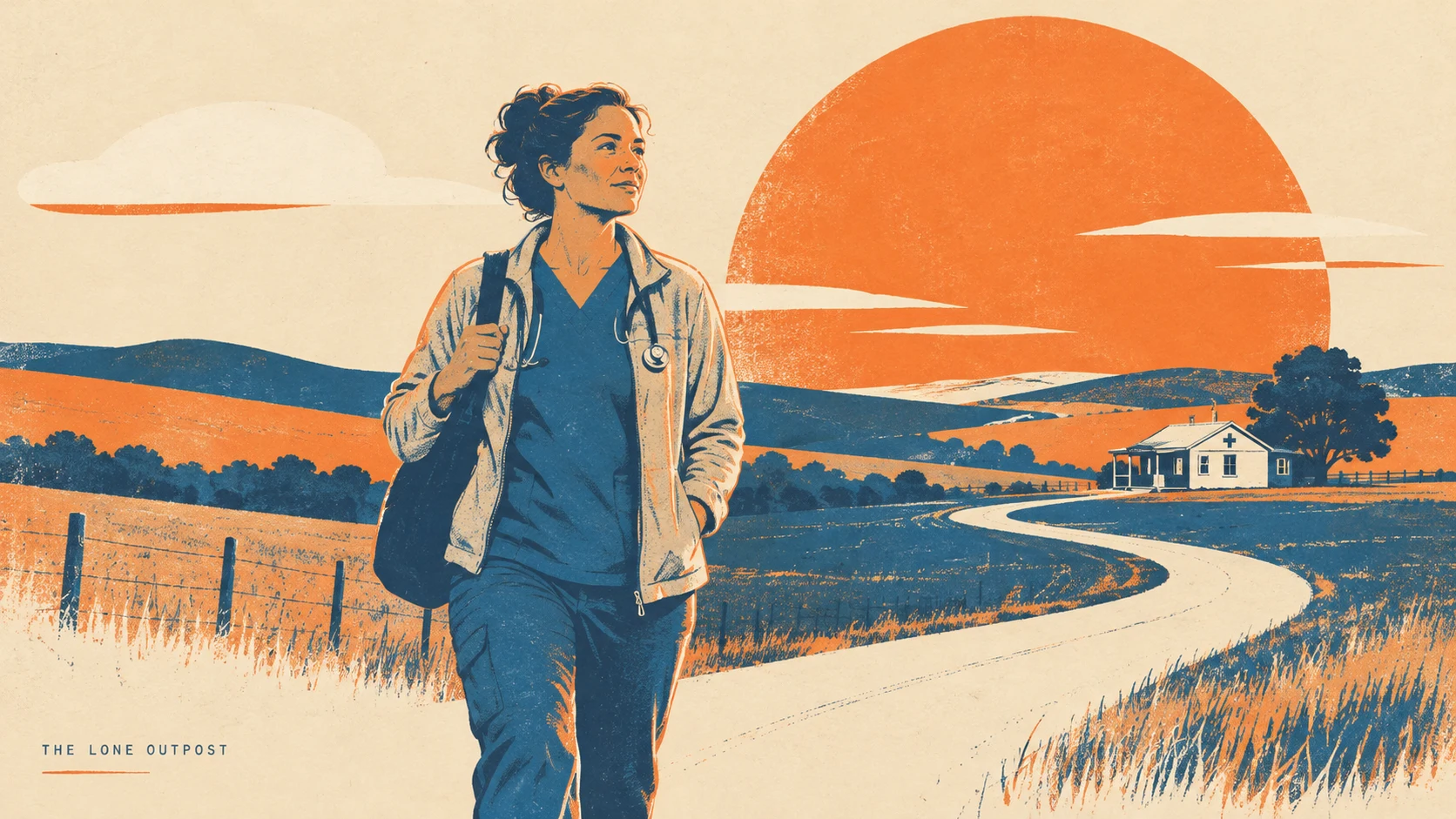
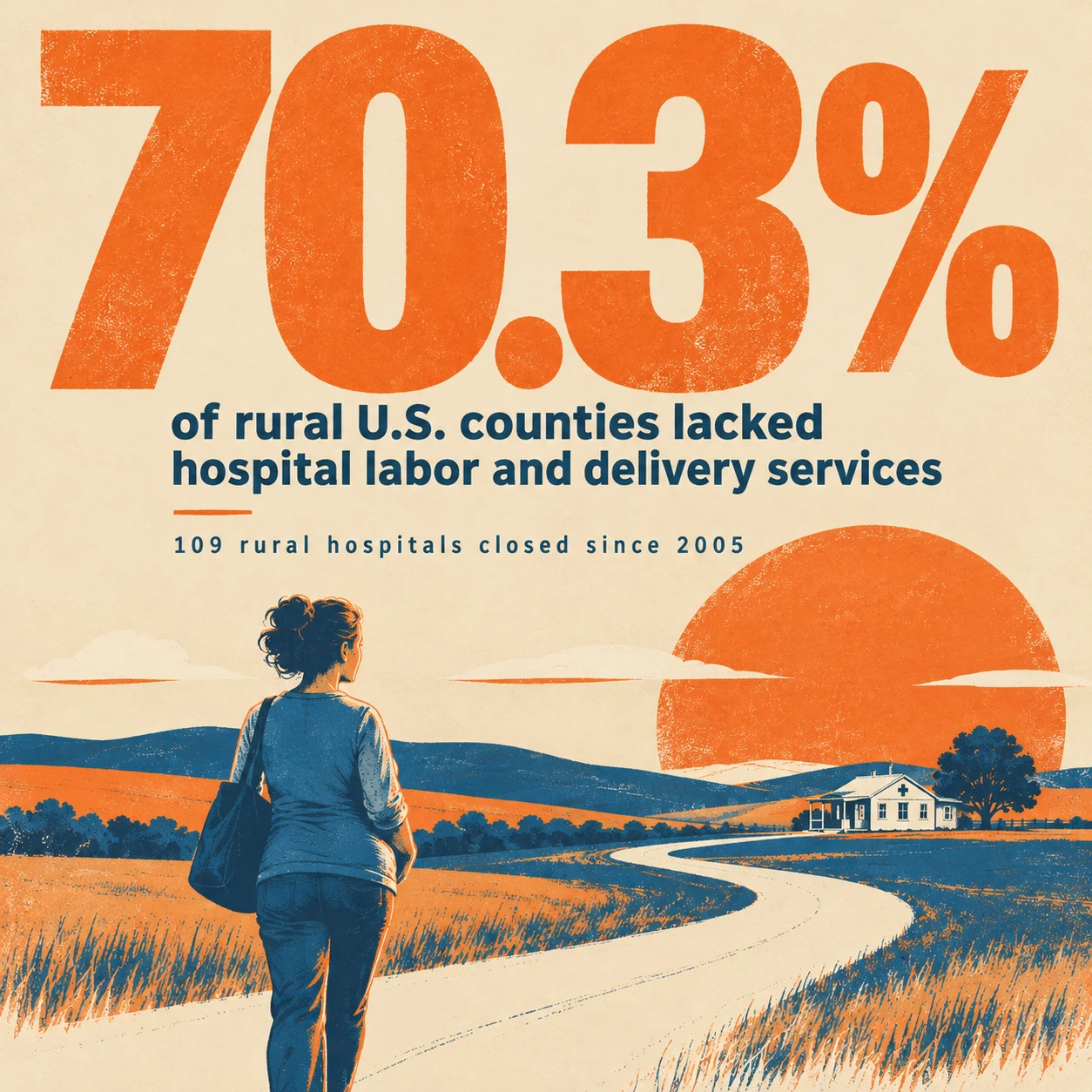
About seven in ten rural U.S. counties do not have a hospital that delivers babies. The 2026 March of Dimes report, using 2024 hospital data, found that 70.3% of rural counties lacked hospital labor and delivery services, compared with 39.2% of urban counties [1]. As of October 7, 2026, 109 rural hospitals had closed outright since 2005, and 88 more had converted to other kinds of healthcare facilities [2].
When a service closes, the patients who needed it are still there. More of their care falls to the clinicians who stay—often a family physician, nurse practitioner, nurse, or paramedic with limited specialist backup [2].
Two skills, one room
Two skills matter especially to the training problem discussed here, and both can be practiced in conversation.
One is the verbal articulation of clinical reasoning: explaining to a patient what might be going on and why the next step matters, or walking a specialist on the phone through a case and making the argument for a plan. The other is the hard conversation itself: asking a question a patient does not want to hear, or staying with him when he pushes back.
Both skills grow through practice with feedback. Distance learning can bring educational content closer to rural clinicians, but access to interactive practice and feedback still depends on how a program is designed and on the time and resources available [11].
A Tuesday afternoon visit
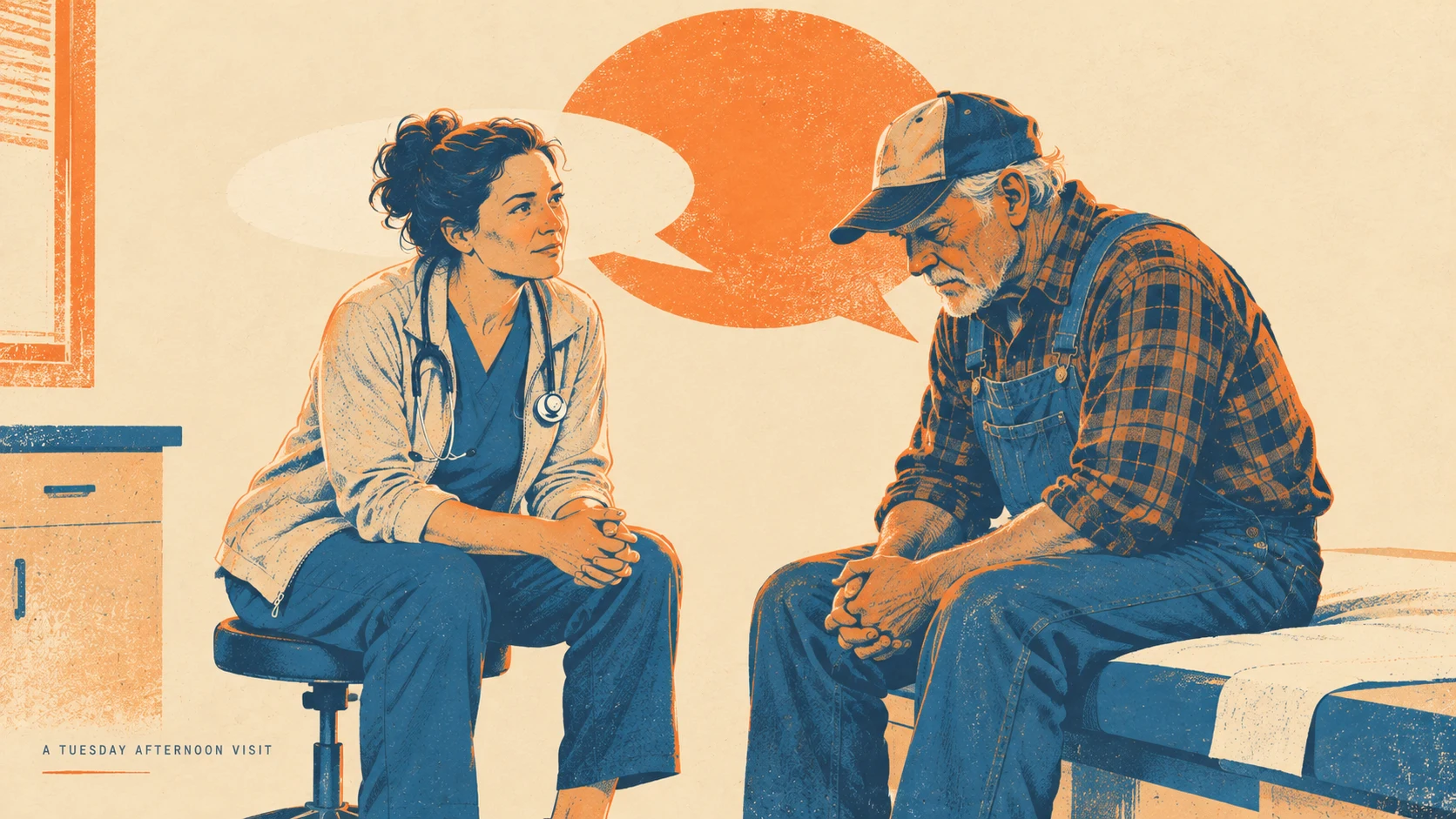
Picture a fictional nurse practitioner named Ruth at a rural health clinic an hour from the nearest hospital. Her 3:00 patient is Walt, a 71-year-old farmer in for a blood pressure check, and Ruth sits on the school board with his wife.
Near the end of the visit, Walt says he is not much use to anybody since he sold the cattle. Ruth knows she should ask him directly about thoughts of suicide.
If he says yes, she will need to assess his current thoughts, any plan, access to lethal means, and immediate safety, then determine the appropriate disposition. Current suicidal thoughts require urgent evaluation, and he should not be left alone; other findings may call for safety planning, lethal-means safety counseling, referral, and follow-up [16].
She will see his wife on Thursday either way. She asks about his sleep instead, renews his prescription, and he goes home.
Rural care runs with less slack
Fewer people to hand off to
Rural health problems are not the same everywhere, and a hospital closure does not hurt every town equally. The effects depend partly on distance, transportation, and the services that remain nearby [2].
A study published in 2025 examined older fee-for-service Medicare beneficiaries and 32 rural hospital closures using 2014–2018 data. It found generally modest changes in the access measures studied, with a small increase in 30-day readmissions after closures of hospitals more than 50 miles from the nearest alternative hospital [3]. The study’s results are associational, and the authors caution that failure to detect an effect is not proof that a closure causes no harm.
What rural systems tend to share is thin backup. HRSA projects a much larger proportional physician shortage in nonmetropolitan areas than in metropolitan areas by 2038: 58% in nonmetro areas compared with 5% in metro areas [4].
Some rural clinicians also have few opportunities to encounter certain high-acuity cases. South Dakota’s mobile simulation program notes that some providers may encounter a critically ill or injured patient only once or twice a year [5]. Reasoning through a case you see that seldom is hard to keep sharp.
Hard conversations come with history
CDC reports that suicide rates are higher in rural communities than in urban ones. In its analysis of 2022 deaths, the age-adjusted suicide rate was 20.0 per 100,000 rural residents, compared with 13.4 per 100,000 urban residents [6].
Rural communities also have fewer behavioral health providers than urban communities [2]. That makes conversations like Ruth’s harder to back up with a timely referral.
Small towns can add another layer. A 2023 narrative review described rural clinicians who are also neighbors, customers, and fellow board members to the people they treat [7]. Those ties can build trust. They can also make privacy and boundaries harder to manage, and a question about suicide feels heavier when you will see the family at church on Sunday.
Learning from a distance
“Kind of feel like the lone outpost”
A qualitative evaluation published in 2026 used interviews and a focus group with 18 rural primary care providers and leaders in the Veterans Health Administration, drawing on data collected in 2021–2022 [8]. The participants included nine primary care providers, six ambulatory-care leaders, and three facility leaders.
They described understaffing, inadequate patient coverage, limited protected time, and professional isolation as barriers. They also reported limited access to professional networks and mentorship. One leader called rural providers “the lone outpost,” and the researchers used the phrase in their title.
Isolation is a human problem, and the answer to it is human too: more peers, more mentors, and more time with colleagues. In the meantime, it also means fewer chances to get feedback on how clinicians talked through a tough case.
Rural programs already know how to do this
Rural health has a long record of solving training problems in creative ways.
A North Carolina program used a nurse-led mobile simulation program to reduce travel costs, staffing shortages, and delays in training for rural nurses [9]. Mobile simulation trucks bring manikins and instructors to small hospitals in states like South Dakota [5]. Project ECHO connects rural clinicians with specialists through live, case-based telementoring sessions [10].
These programs offer complementary ways to bring training closer to rural clinicians: mobile simulation brings coached rehearsal to local teams, while ECHO brings specialist guidance and peer learning through case-based discussion. They should remain part of the training mix.
Knowing is not the same as doing
Distance learning can help. A systematic review of distance learning for rural allied health practitioners found that some approaches produced learning outcomes and satisfaction comparable to face-to-face education. The 14 included studies used several formats, including videoconferencing, telephone sessions, and web-based learning [11].
But a module on suicide risk is different from saying the words to Walt and then talking him through what happens next. The studies cited here do not establish how often rural clinicians receive rehearsal with feedback. Distance learning can reduce travel barriers, although connectivity and protected time still affect access [2, 8]. Many forms of coached practice require an instructor, actor, or colleague to be available.
Where virtual humans fit
Practice, not a replacement for people
Here, virtual humans means AI-driven simulated people that learners can converse with, sometimes through an on-screen avatar. The research category of virtual patients is broader and also includes text-only systems.
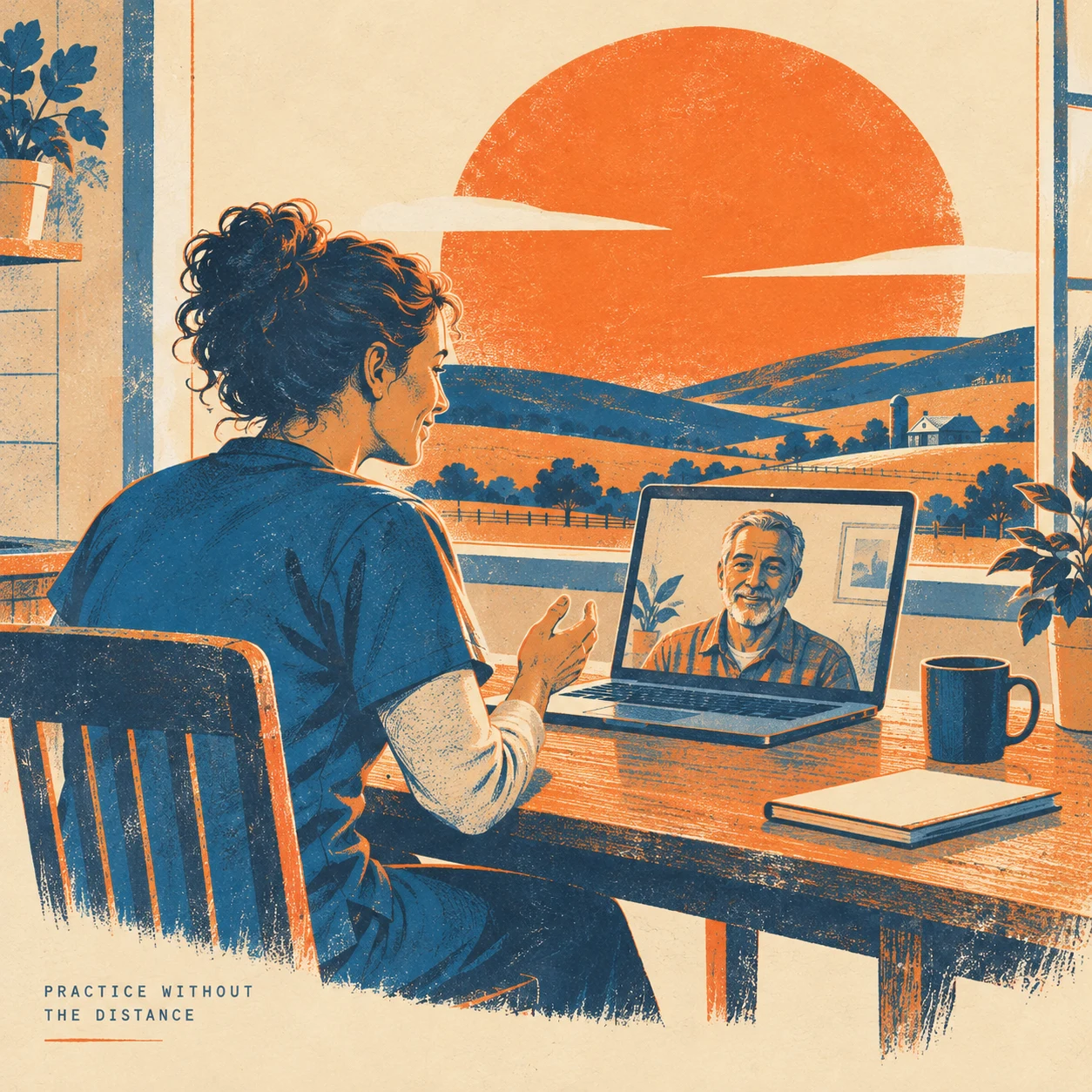
Virtual humans will not fix rural isolation. The clinicians in the VA study wanted mentors, peers, and a sense of connection, and a simulated patient is not any of those. What a virtual human can offer is additional practice where access to coached rehearsal is limited. That practice can sit alongside the human support rural clinicians need.
Practice that fits around a shift
Depending on the platform and course design, conversational simulations may offer the following kinds of practice:
- On voice-enabled platforms, a clinician can talk out loud with a virtual patient using a supported device.
- A virtual patient may respond differently to rushed questions and thoughtful listening.
- A clinician may practice explaining to a worried patient why a symptom can or cannot wait.
- A program could also build a virtual-consultant scenario in which the clinician presents a case and defends a plan.
- Depending on the platform, the learner may receive automated feedback and scores based on a defined rubric, then repeat the exercise during another protected learning period.
- Programs can build courses around the cases and conversations their staff find hardest and ask staff to practice more than once.
- Aggregate results may help identify areas for further teaching.
Those scores need to be checked against expert judgments before programs rely on them to assess competence. The research evidence also identifies limitations in the emotional responsiveness, adaptability, and assessment validity of current systems [15].
What the research shows
The evidence is encouraging and still early. Earlier virtual-patient research largely examined screen-based clinical cases. It provides background evidence for simulation, but it does not directly establish the effectiveness of today’s conversational AI avatars [12].
A 2019 review included 51 trials with 4,696 learners. Its pooled comparisons with traditional teaching found no statistically significant difference in knowledge scores and favored virtual patients for skills, including clinical reasoning. However, the quality of evidence was generally low and results varied substantially [12].
A separate review of digital education among medical students found no statistically significant pooled communication-skill advantage over traditional methods. That finding does not establish equivalence or lack of benefit; the included evidence was low quality and heterogeneous [13].
A randomized trial reported in a 2026 preprint involved 51 medical, nursing, and physician assistant students and practicing clinicians. Participants received either AI virtual-patient practice with automated feedback or an equal-duration reading module covering the same serious illness communication framework. The AI group improved more on communication scores assessed in standardized-patient encounters [14].
That trial compared a package of interactive practice plus automated feedback with reading. It did not compare AI practice with human standardized-patient training, and it did not isolate which component caused the improvement. It also did not establish whether those gains carried over to real patient care [14].
What it does not show yet
A 2026 systematic review, searching through March 19, included 15 studies of generative AI virtual patients with 645 participants. Most studies were small, interventions were usually brief, and there was little longitudinal follow-up. The review reported six studies using embodied avatars and nine using nonembodied interfaces, although its detailed reporting of modalities contains some inconsistencies [15].
The cited evidence does not establish effectiveness specifically among rural clinicians, and transfer to real patient care remains uncertain [15].
Where to start
A practical pilot could start by asking staff two questions: Which conversation with a patient do they dread most, and which case do they find hardest to talk through with a consultant on the phone?
The answers might be asking about suicide, explaining why a referral two hours away cannot wait, or presenting a sick patient to a specialist who has never seen them. Build practice around one or two of those, have everyone try them more than once, and compare the scores with what supervisors and mentors see.
Keep the live classes, ECHO sessions, and mobile simulation in place, and give staff a way to bring what they practiced to a mentor or peer group. Whether this kind of practice changes what happens with real patients is still unproven, and programs that track it can help answer that.
If Ruth had practiced a visit like Walt’s a few times first, the question might have come easier. She would still want a colleague to call afterward, and building those connections matters just as much.
References
- March of Dimes. Maternity Care Deserts, 2026 Report: Hospital-based labor and delivery services. PeriStats. https://www.marchofdimes.org/peristats/reports/united-states/maternity-care-deserts/hospitals
- Rural Health Information Hub. Healthcare Access in Rural Communities. Updated October 7, 2026. https://www.ruralhealthinfo.org/topics/healthcare-access
- Hoffman GJ, Ha J, Fan Z, Li J. Associations between rural hospital closures and acute and post-acute care access and outcomes. Health Services Research. 2025;60(3):e14426. doi:10.1111/1475-6773.14426. https://pmc.ncbi.nlm.nih.gov/articles/PMC12120529/
- Health Resources and Services Administration, Bureau of Health Workforce. Health Workforce Projections. Updated December 2025. https://bhw.hrsa.gov/data-research/projecting-health-workforce-supply-demand
- Simulation in Motion–South Dakota. About SIM-SD. https://sim.sd.gov/about/
- Cammack AL, Stevens MR, Naumann RB, et al. Vital Signs: Suicide rates and selected county-level factors — United States, 2022. MMWR Morbidity and Mortality Weekly Report. 2024;73(37):810–818. doi:10.15585/mmwr.mm7337e1. https://www.cdc.gov/mmwr/volumes/73/wr/mm7337e1.htm
- Szumer RTO, Arnold M. The ethics of overlapping relationships in rural and remote healthcare: a narrative review. Journal of Bioethical Inquiry. 2023;20(2):181–190. doi:10.1007/s11673-023-10243-w
- Miller KL, Hale-Gallardo J, Wilson JR, Swee ML, Tovar LI, Hicken B. “Kind of feel like the lone outpost”: a qualitative exploration of barriers to professional development for rural primary care providers at the Veterans Health Administration. Journal of Rural Health. 2026;42(3):e70206. Published August 18, 2026. doi:10.1111/jrh.70206. https://pmc.ncbi.nlm.nih.gov/articles/PMC13483286/
- Smith SD, Thompson CE, Sims S. Adapting a nurse-managed mobile simulation program to meet rural health nursing continuing education needs. Journal of Continuing Education in Nursing. 2020;51(2):82–86. doi:10.3928/00220124-20200115-07
- Rural Health Information Hub. Using Project ECHO to train healthcare workforce. https://www.ruralhealthinfo.org/toolkits/telehealth/2/workforce-development/education-training/project-echo
- Berndt A, Murray CM, Kennedy K, Stanley MJ, Gilbert-Hunt S. Effectiveness of distance learning strategies for continuing professional development (CPD) for rural allied health practitioners: a systematic review. BMC Medical Education. 2017;17:117. doi:10.1186/s12909-017-0949-5
- Kononowicz AA, Woodham LA, Edelbring S, et al. Virtual patient simulations in health professions education: systematic review and meta-analysis by the Digital Health Education Collaboration. Journal of Medical Internet Research. 2019;21(7):e14676. doi:10.2196/14676
- Kyaw BM, Posadzki P, Paddock S, Car J, Campbell J, Tudor Car L. Effectiveness of digital education on communication skills among medical students: systematic review and meta-analysis by the Digital Health Education Collaboration. Journal of Medical Internet Research. 2019;21(8):e12967. doi:10.2196/12967
- Haut KG, Hasan M, Carroll T, Epstein RM, Sen T, Hoque E. The effects of generative AI virtual patient in serious illness communication skills: randomized controlled trial. JMIR Preprints. Submitted February 20, 2026; preprint 93034. doi:10.2196/preprints.93034. https://preprints.jmir.org/preprint/93034
- Jiang J, Ye MZ, Kwok TTO, Wong JYH. GenAI-supported virtual patients in health care education: systematic review. Journal of Medical Internet Research. 2026;28:e82756. doi:10.2196/82756. https://www.jmir.org/2026/1/e82756
- National Institute of Mental Health. Adult Outpatient Brief Suicide Safety Assessment Guide. https://www.nimh.nih.gov/research/research-conducted-at-nimh/asq-toolkit-materials/adult-outpatient/adult-outpatient-brief-suicide-safety-assessment-guide