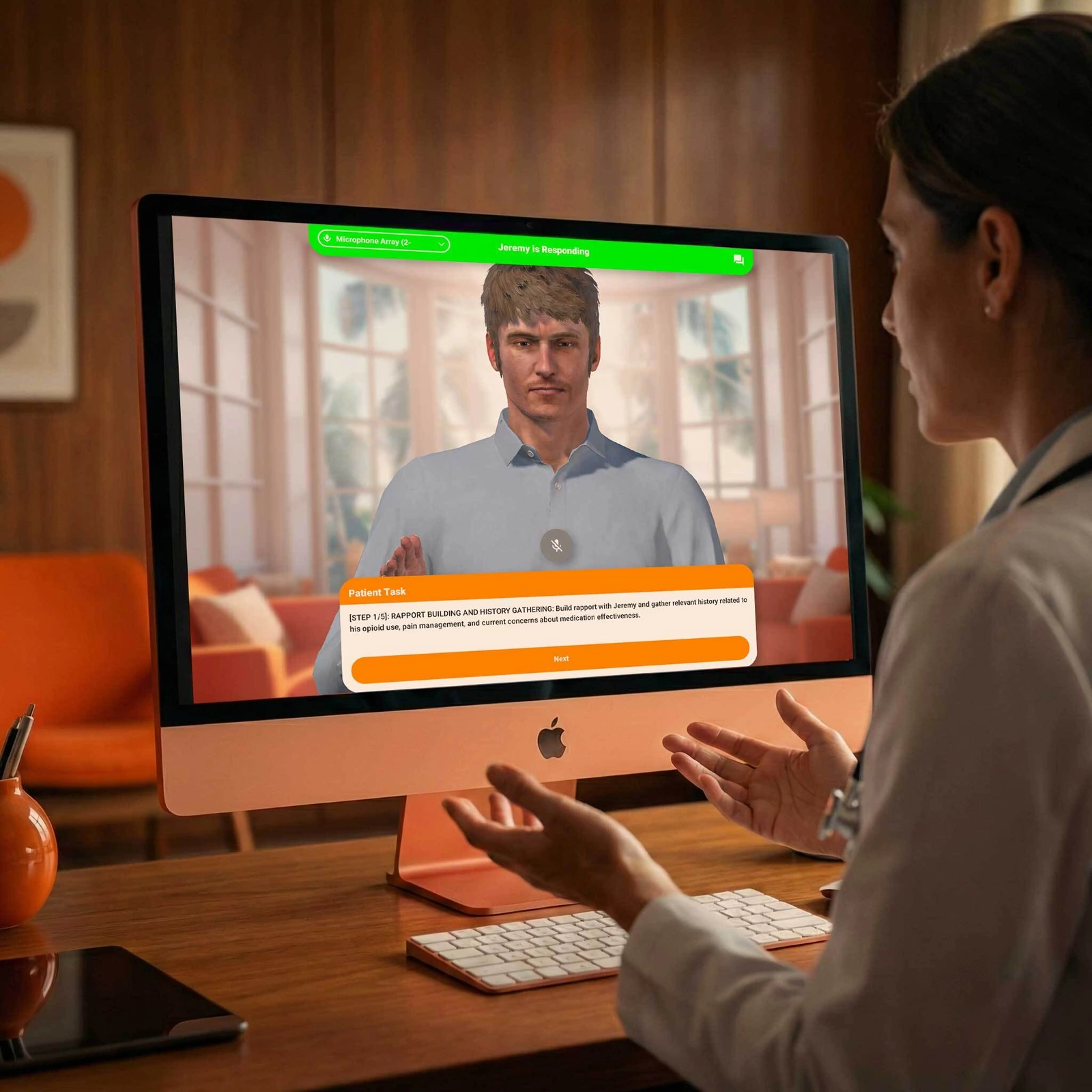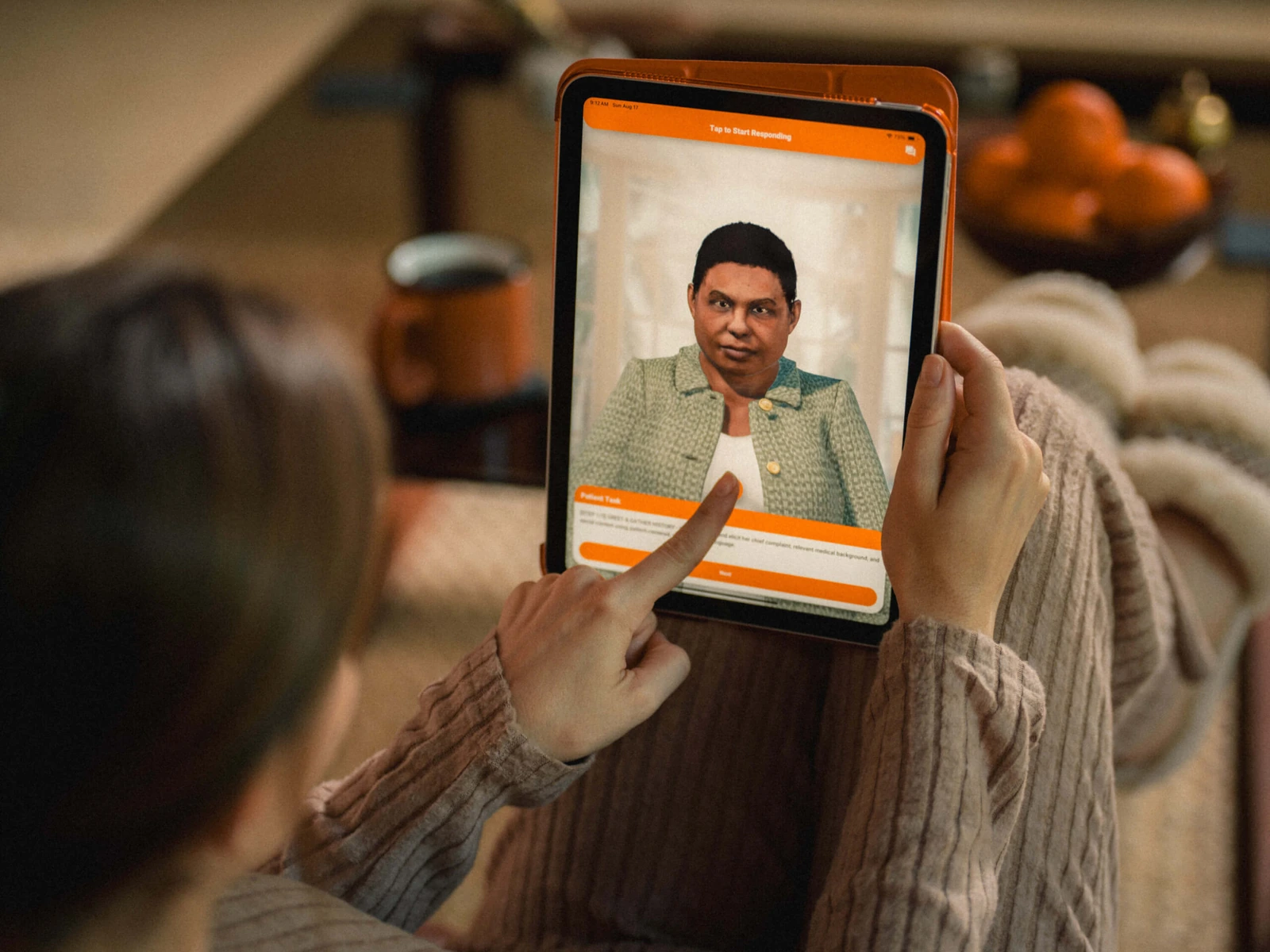
Case study Obesity care
Practicing motivational interviewing for obesity care
Clinicians worked through a conversation with Charlotte, then received feedback on how they used motivational interviewing.


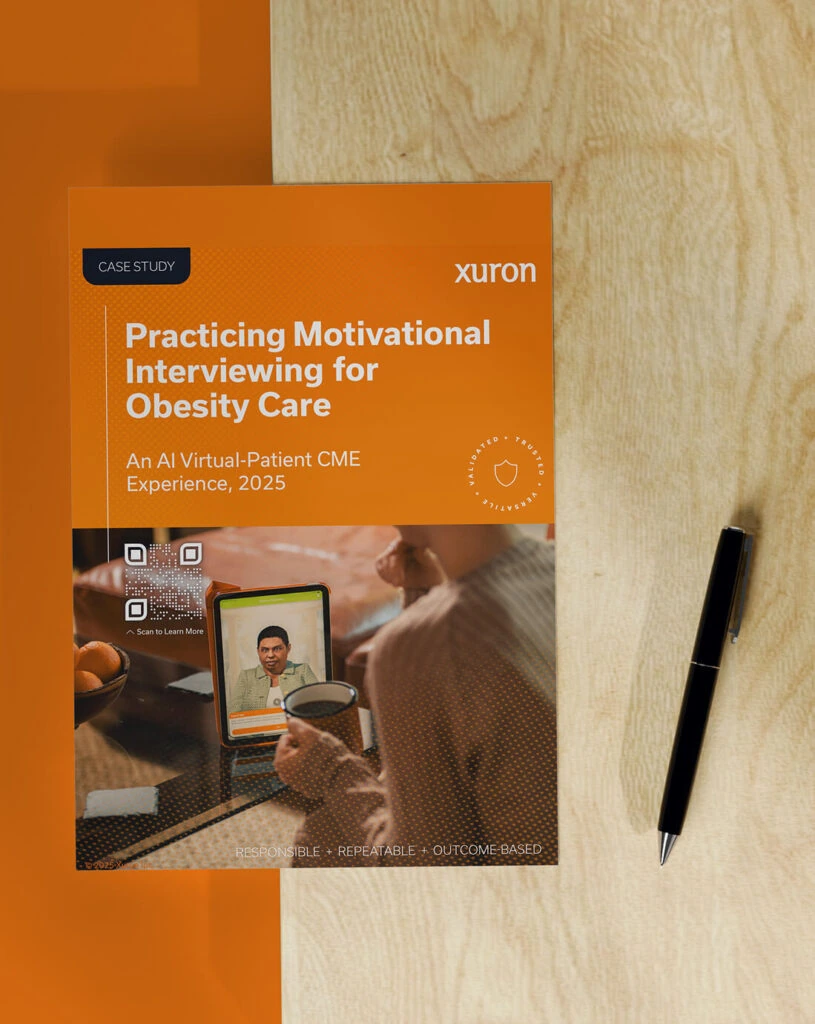 Read the full story
 In the literature
 Published in the ACEhp Almanac
 - unique clinicians
- 16
- completed sessions
- 18
- conversation tasks
- 5
The approach
Help Charlotte make a plan she can use.
The challenge
Knowing what to recommend is only part of an obesity conversation. Clinicians also need to listen, use respectful language, explore a patient’s own motivation, and agree on a practical plan.
The activity
Pri-Med’s online activity combined a short introduction to motivational interviewing with a virtual-patient encounter and immediate feedback. This early evaluation explored learning and the skills demonstrated during the conversation.
Inside the encounter
Meet Charlotte.
Charlotte is a 40-year-old virtual patient with class 2 obesity, type 2 diabetes, and hypertension. Learners practice exploring her perspective and working together on realistic changes, rather than simply delivering advice.
Listen and understand
Build rapport and gather the patient’s history.
Explore motivation
Connect lifestyle choices to the patient’s priorities using open questions and reflective listening.
Make a plan together
Develop specific, achievable goals and confirm next steps.
Review the conversation
Receive task-level scores and feedback on strengths and opportunities.
Results & insights
Where learners improved and where they needed practice
Correct responses increased on the person-first language question and stayed unchanged on the OARS question. During the encounter, explaining lifestyle benefits scored lower than creating SMART plans. The measures below show different aspects of learning.
Explore the full reportBoth knowledge questions
Percentage of correct responses before and after the activity.
Before activityAfter activity
- Preferred person-first wording
- Identifying a component of OARS
18 completed sessions. The person-first language item increased by 22.2 percentage points; the OARS item was unchanged. OARS refers to open questions, affirmations, reflective listening, and summaries.
Confidence in each knowledge answer
Percentage choosing “I’m sure” when answering each question, before and after the activity.
Before activityAfter activity
- Person-first wording question
- OARS question
Confidence describes how certain learners felt about their answers. It is separate from whether the answer was correct and how they performed in the encounter.
Comfort with conversation skills
Self-reported mean ratings on a five-point scale, before and after the activity.
Before activityAfter activity
- Person-first language
- Motivational interviewing
- Eliciting lifestyle ideas
- Creating SMART plans
Reported session-level means. Comfort ratings describe learner perceptions; they are separate from demonstrated performance.
All five conversation tasks
Mean simulation task scores on a five-point scale.
- Greet and gather history
- Discuss lifestyle benefits
- Use motivational interviewing
- Create SMART plans
- Summarize and confirm next steps
These are scores during the simulated encounter, not pre/post changes. The activity used automated scoring.
Make room for the patient
Some conversations became clinician monologues or moved quickly into instructions. Reflective listening creates more space for the patient’s perspective.
Connect the plan to a reason
Explaining how a change relates to the patient’s health was harder than constructing the plan itself.
Turn a goal into a next step
Vague goals and limited exploration of barriers created opportunities for more specific, collaborative follow-up.
Study context
How to read
these results
How it was evaluated
An early, single-arm evaluation of 18 sessions completed by 16 clinicians between June 30 and August 10, 2025.
The activity collected knowledge responses, confidence in those answers, self-reported comfort, simulation task scores, perceived value, and written feedback. Results were descriptive; no inferential significance testing was performed.
What this evaluation can tell us
The cohort was small and self-selected, and some clinicians completed more than one session. Session counts and unique learner counts are not interchangeable.
The evaluation did not include a control group or assess lasting skills or patient-level outcomes. Automated scoring requires further validation.
The Pri-Med activity was supported by an educational grant from Eli Lilly.
Read the Almanac publicationThe full case study
Read the full evaluation
The full report includes the study design, participant context, detailed measures, and findings.
Download case study PDF report Also published in the Almanac