Case study Opioid education
Practicing opioid care with Jeremy
How clinicians approached screening, treatment, and patient concerns in Pri-Med’s virtual-patient activity.

 Read the full story
 - completed learner sessions
- 390
- encounter tasks
- 5
- CME / CE credits
- 0.5
The approach
Work through an opioid care consultation.
The challenge
Conversations about opioid use disorder involve more than recalling guidance. Learners need to ask sensitive questions, recognize concerns, discuss options, and work toward a plan with the patient.
The activity
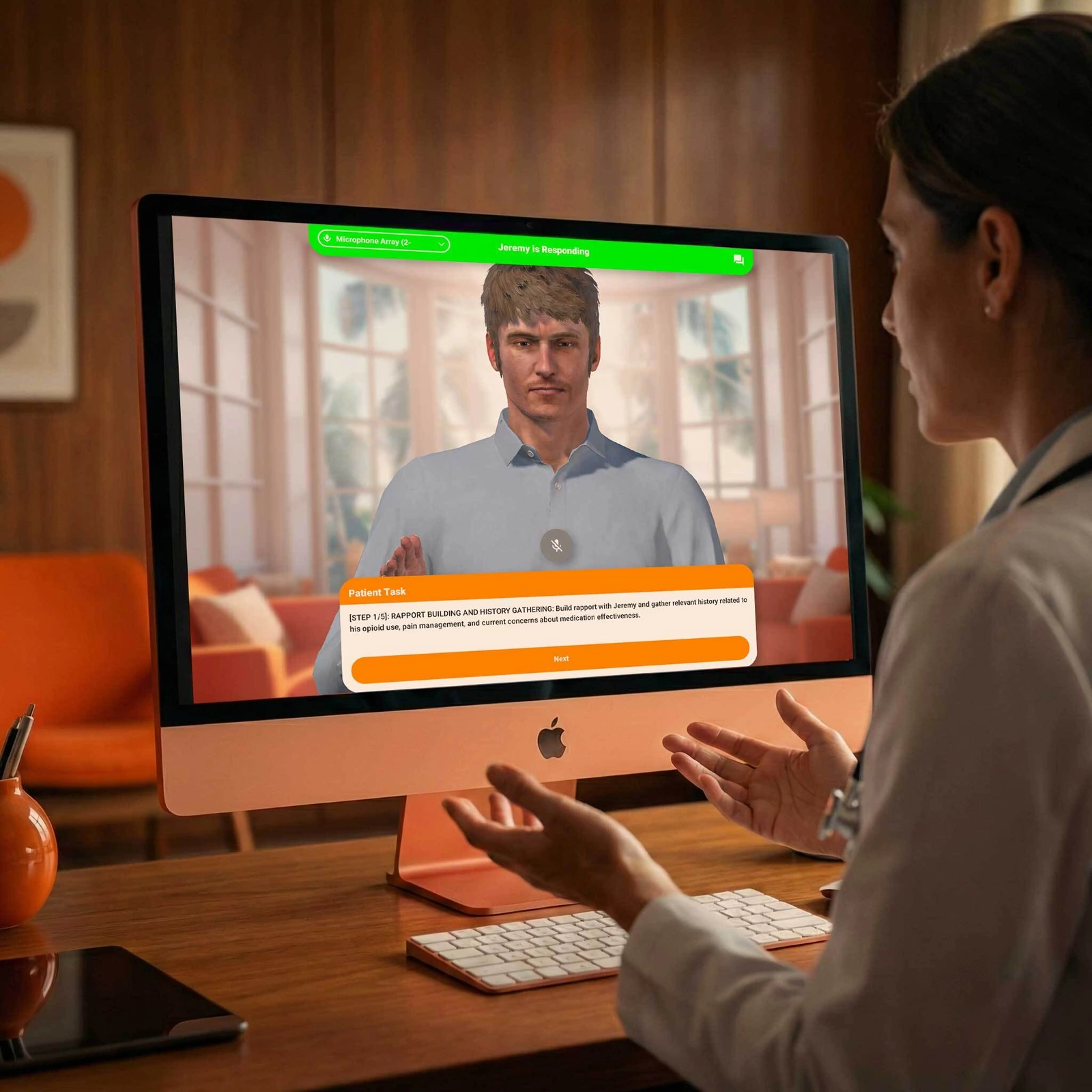
Part four of Pri-Med’s Safe and Effective Pain Care curriculum paired short educational content with an open-ended virtual-patient encounter, pre/post assessment, and task-level feedback.

Inside the encounter
Meet Jeremy Thompson.
Jeremy is a 34-year-old warehouse supervisor returning for chronic back pain. He reports that his medication no longer lasts the whole month, opening a conversation about symptoms, medication use, and next steps.
Build rapport
Listen to Jeremy’s concern and gather his history.
Screen and assess
Practice screening and diagnostic reasoning within the scenario.
Discuss treatment
Use motivational interviewing to explore options and readiness.
Plan for safety
Discuss follow-up and harm reduction, then review feedback on the encounter.
Results & insights
What the assessments and conversations showed
Correct responses increased on each of the three knowledge items. Performance during the conversation offered a separate view of the tasks learners found easier or more challenging.
Explore the full reportCorrect responses before and after
Item-level results across 390 completed learner sessions.
Before activityAfter activity
- Recognizing the screening tool
- Recognizing diagnostic criteria
- Selecting the next clinical step
These are whole-activity pre/post results. Differences are percentage points; the contribution of simulation alone was not isolated.
Performance across the encounter
Reported mean task scores on a five-point scale.
- Rapport and history
- Screening
- Diagnostic assessment
- Brief intervention and MOUD discussion
- Treatment planning and harm reduction
Task-level simulation scores from the report. A high score on one task does not establish overall clinical readiness.
Explore the emotional cue
Learners often identified concerns without exploring them deeply. Acknowledging the impact of pain can help make the exchange more relational.
Give screening a clear context
The analysis identified abrupt transitions and imprecise screening questions as opportunities for improvement.
Carry the conversation through
Planning and harm reduction were harder than diagnostic assessment, highlighting the importance of what happens after recognition.
Study context
How to read
these results
How it was evaluated
The report covers 390 completed learner sessions from December 1, 2025 through January 5, 2026, with pre/post assessments and task-level feedback.
Measures included knowledge, self-reported confidence, simulated performance, learner value, written comments, and intended future actions. This cohort is separate from the June 2026 participation figures elsewhere on this site.
What this evaluation can tell us
This is an evaluation of a combined educational activity. It does not isolate a simulation-only effect or establish patient-level outcomes.
Intentions to change practice are self-reported. They should not be interpreted as verified treatment decisions or follow-through.
The REMS-aligned activity was supported by an independent educational grant from the Opioid Analgesic REMS Program Companies.
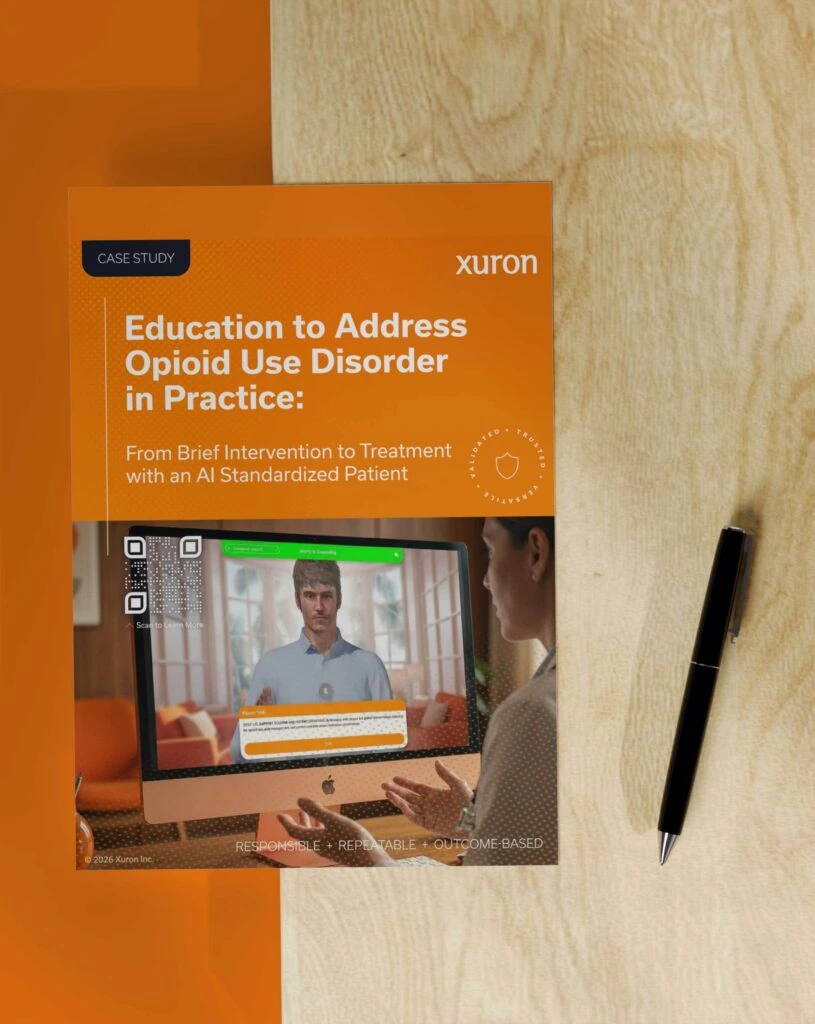
The full case study
Read the full evaluation
The full report includes the study design, participant context, detailed measures, and findings.
Download case study PDF report