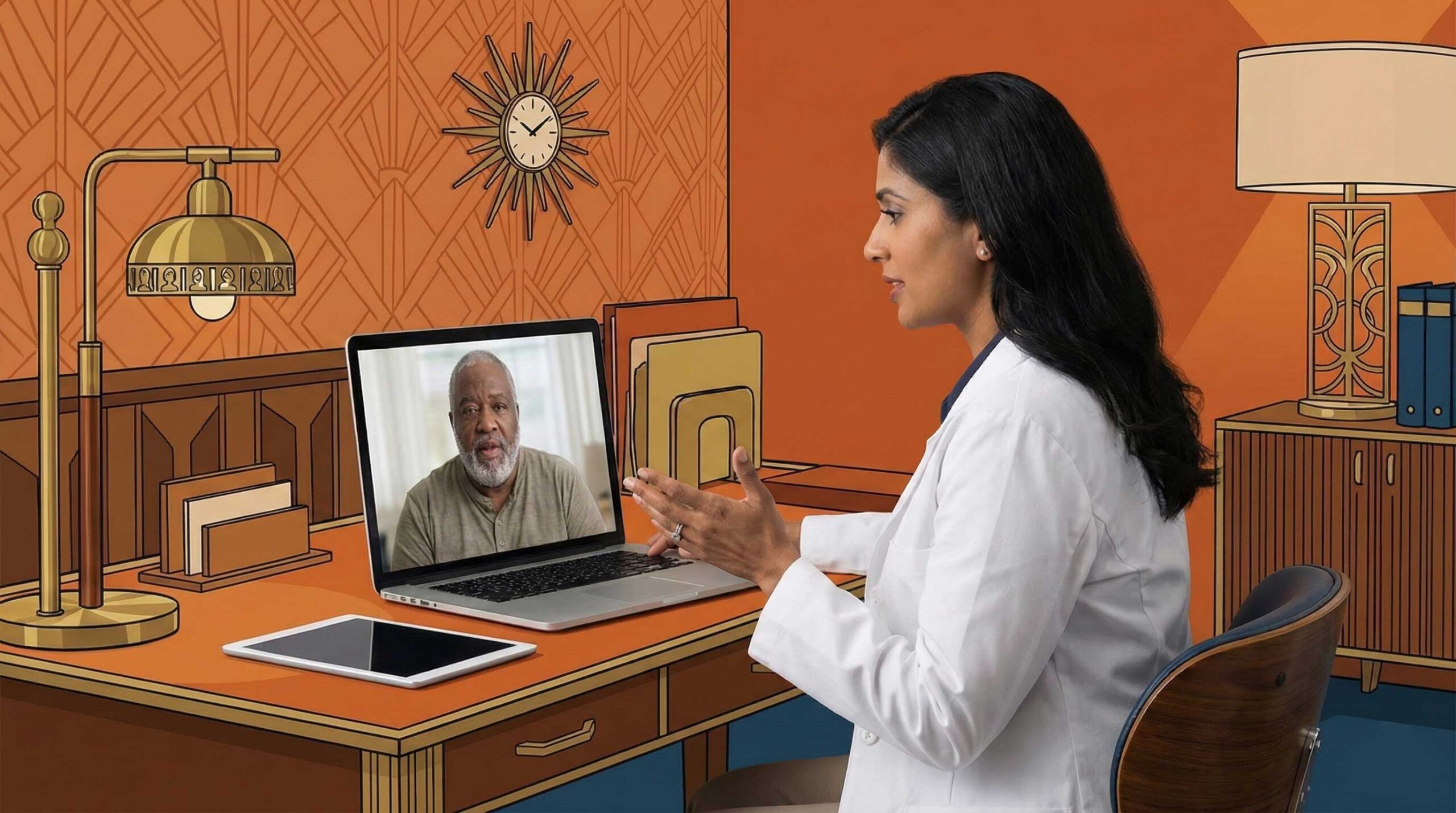
AI-Enhanced Telehealth Communication Training
Telehealth is no longer an experiment or a stopgap. It is a stable part of how care is delivered across medicine, nursing, advanced practice, and allied health. As that shift has settled in, a quiet realization has followed: remote care is not simply in-person care delivered through a screen or a phone. It is a different clinical interaction, with different communication constraints, safety risks, and equity considerations.[1]
This recognition has reshaped how telehealth skills are taught in undergraduate medical education (UME), graduate medical education (GME), and continuing professional development. In parallel, artificial intelligence (AI) has entered the field, not as a replacement for educators or standardized patients, but as a way to scale practice and feedback in a training environment that is otherwise difficult to expand.
What follows is a synthesis of where telehealth communication training stands today, how AI is being used in this space, and why the evidence increasingly points toward hybrid models that combine AI-enabled deliberate practice with human-validated assessment.
Telehealth Competence Is Converging Across Frameworks
Across U.S. and international professional bodies, telehealth competence has begun to coalesce around a shared set of domains: patient-centered communication, remote data gathering and assessment, technical fluency, ethical and legal awareness, and attention to equity and access. The AAMC, ACGME, AMA, and parallel interprofessional organizations all reflect these themes, even when articulated through different lenses or embedded within broader competency structures.[2-4]
The important shift is not the wording of any single framework, but the collective acknowledgment that telehealth skills are distinct, observable, and teachable, rather than assumed extensions of in-person care.

Before AI: Simulation and Tele-OSCEs Built the Foundation
Long before generative AI entered medical education, simulation was the primary tool used to teach and assess telehealth communication skills.
Tele-OSCEs Exposed Hidden Gaps
Objective Structured Clinical Examinations (OSCEs) adapted for telehealth have repeatedly shown that clinicians and trainees often perform well on general communication while missing telehealth-specific behaviors. In one TeleHealth OSCE involving internal medicine residents, only a small proportion of encounters demonstrated effective use of video to support history-taking or a structured approach to the virtual physical exam.[5] These findings revealed that telehealth-specific skills do not reliably emerge through clinical exposure alone.
Making Telehealth Skills Observable
Subsequent curricula integrated tele-OSCEs with structured debriefing and checklists, enabling educators to observe behaviors such as privacy verification, discussion of telehealth limitations, and adaptation of physical examination techniques.[6] Similar approaches have been adopted in nursing and other health professions, where telehealth simulation has been shown to increase learner confidence and perceived readiness for virtual care.
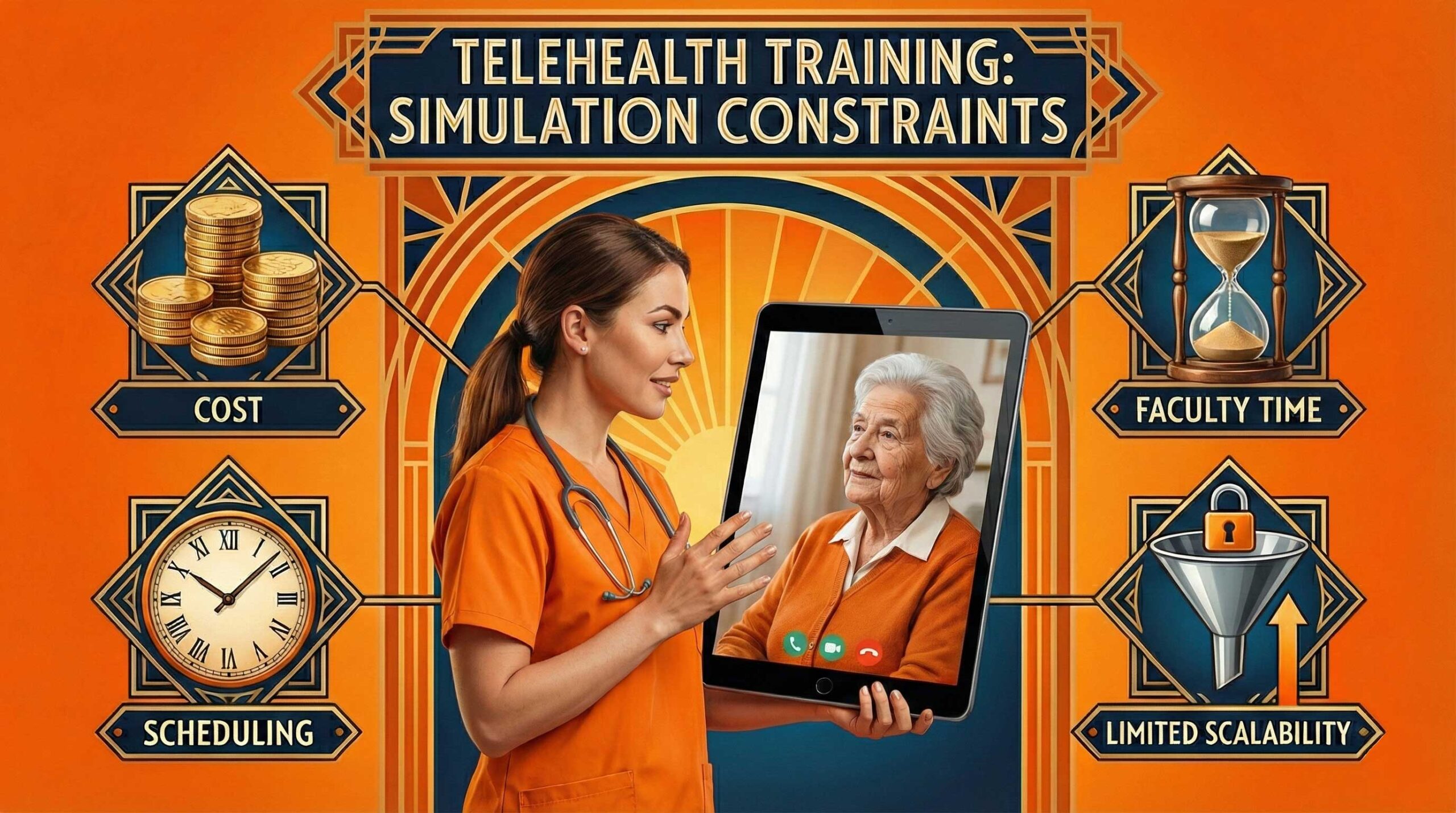
Simulation worked, but it came with familiar constraints: cost, scheduling, faculty time, and limited scalability.
Why AI Entered Telehealth Training at All
AI did not enter telehealth education because it was fashionable. It entered because telehealth training has a structural problem: clinicians need repeated practice and timely feedback, and human-mediated simulation does not scale easily.
AI’s role, at least in the peer-reviewed literature, is not to replace human educators but to multiply practice opportunities and shorten feedback loops.
Where AI Is Being Used in Telehealth Communication Training
Generative AI for Telehealth Simulation
One peer-reviewed example comes from midwifery education, where a generative AI platform was piloted to support person-centered, culturally responsive telehealth simulations. Learners interacted with adaptive virtual patients capable of responding dynamically to clinical dialogue, allowing exposure to a wider range of scenarios than traditional standardized patient programs could feasibly offer.[7] The educational value here lies in variation, repetition, and dialogue-driven practice within a telehealth context.
Another example from nursing education evaluated ChatGPT-based AI dialogues and simulated scenarios to prepare baccalaureate nursing students for primary care telehealth practicums, demonstrating feasibility in preparing students for telephone-based patient encounters.[8]
Voice-Based AI and the Reality of Phone Visits
Despite the emphasis on video, a substantial proportion of telehealth encounters remain audio-only. Training for telephone communication is therefore not optional.
A 2025 pilot study evaluated an AI voice-driven simulation in which clinicians practiced delivering sensitive diagnostic information over a simulated phone encounter and received structured, immediate feedback afterward.[9] Immediate feedback allows clinicians to reflect and adjust while the encounter is still cognitively fresh, rather than waiting for delayed faculty review.
Immediate Feedback as the Quiet Advantage
Across AI-enabled telehealth training studies, one feature appears repeatedly: speed of feedback.
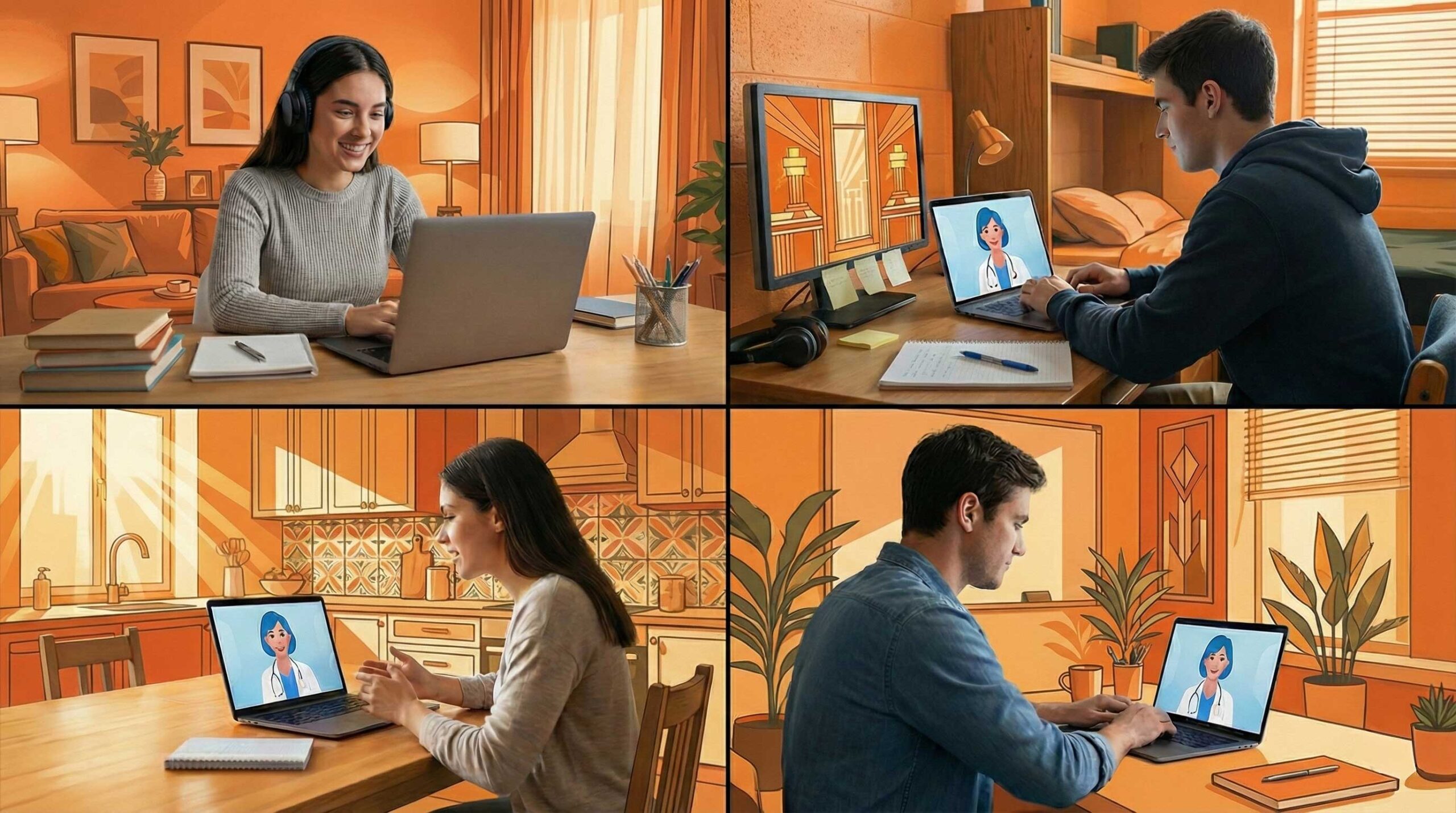
AI systems can analyze dialogue structure, timing, and content immediately after a simulated encounter, providing clinicians with actionable insights without additional faculty burden. This supports deliberate practice models in which clinicians iterate quickly, refining communication behaviors over multiple short cycles rather than single high-stakes simulations.[10]
This pattern is consistent across multiple strands of the literature. Studies evaluating AI-generated feedback on clinician communication show that learners rate the feedback as accurate and useful, and that exposure to immediate feedback is associated with greater use of targeted communication techniques over time.[11] In parallel, AI-based analysis of real clinician–patient conversations has demonstrated the feasibility of automatically identifying social signals such as engagement, warmth, and conversational balance, and returning structured feedback summaries that clinicians find interpretable and actionable.[12]
Reviews of AI use in health professions education reinforce this theme: while implementations remain early, immediate feedback is consistently identified as one of the strongest contributors to learner engagement, confidence, and sustained practice.[13]

The Case for Hybrid Models: AI for Practice, Humans for Validation
As evidence accumulates, a clear pattern is emerging: AI performs best when used for formative practice, while human-facilitated encounters remain essential for summative assessment.
In hybrid models, clinicians use AI-driven simulations to practice telehealth conversations repeatedly, receiving immediate feedback aligned to predefined rubrics. Once foundational skills are established, competence is validated through tele-OSCEs or standardized patient encounters observed by faculty, where nuanced judgment, contextual awareness, and professional presence can be assessed reliably.
This approach mirrors broader recommendations in recent simulation reviews, which emphasize using AI as a scaling mechanism for design and feedback while maintaining strict governance and human oversight for high-stakes evaluation.[14]
What the Evidence Supports, and What It Does Not—Yet
The current peer-reviewed literature supports several conclusions:
- AI-enhanced telehealth simulations are feasible and acceptable to clinicians across training levels.[7-9]
- AI can deliver immediate, structured feedback that supports deliberate practice.[9-13]
- Hybrid models align well with existing educational frameworks and assessment needs.[14]
At the same time, important gaps remain. Longitudinal evidence linking AI-based telehealth training to sustained improvements in real clinical encounters is limited. Assessing nonverbal communication in video visits remains challenging for AI systems. Governance, bias, and alignment between AI feedback and expert judgment require continued scrutiny. Systematic reviews of virtual simulation tools underscore both the promise and the immaturity of the evidence base.[15]
Where This Leaves Telehealth Education
Telehealth communication training has moved from informal advice to structured competency, simulation, and assessment. AI is increasingly being integrated not as a disruptive replacement, but as an enabling layer that expands access to practice and accelerates feedback.
The most defensible direction, based on current evidence, is a combined model: AI-enabled deliberate practice for scale and efficiency, paired with human-validated OSCEs and expert review for final competence judgments. As telehealth remains embedded in routine care, this hybrid approach is likely to define how future clinicians learn to communicate effectively at a distance.
References
- Wootton R. Telemedicine: a cautious welcome. BMJ. 1996;313(7069):1375-1377.
- Association of American Medical Colleges. Telehealth Competencies Across the Learning Continuum. AAMC; 2021.
- Accreditation Council for Graduate Medical Education. ACGME Common Program Requirements (Residency). ACGME; 2025.
- American Medical Association. Telehealth Implementation Playbook. AMA; 2024.
- Sartori DJ, Hayes RW, Horlick M, Adams JG, Zabar SR. The TeleHealth OSCE: preparing trainees for telemedicine as a tool for transitions of care. Acad Med. 2020;95(3):e1-e5.
- Bajra R, et al. Training future clinicians in telehealth competencies: outcomes of a telehealth curriculum and tele-OSCEs at an academic medical center. Front Med (Lausanne). 2023;10:1222181.
- McGrew HC, et al. Telehealth simulations with generative artificial intelligence in midwifery education: person-centered care. J Midwifery Womens Health. 2025;70(6):932-938.
- Paul LD. Evaluation of ChatGPT artificial intelligence dialogues and simulated scenarios to prepare nursing students for telehealth practicum. Med Res Arch. 2025;13(7).
- Comulada WS, et al. A pilot test of an AI voice-driven simulation with feedback for medical students to practice discussing diagnostic mammogram results with patients. Cureus. 2025;17(10):e95606.
- Rozenfeld B, Nott I, Whitmore W. AI-enhanced simulation for telehealth communication training. ACEhp Almanac. May 21, 2025.
- Herschbach L, et al. Artificial intelligence–based chatbot providing real-time feedback on communication techniques. J Med Internet Res. 2025;27:e82818.
- Bedmutha MS, et al. Automated assessment of social signals in clinical conversations using artificial intelligence. JAMIA Open. 2024;7(4):ooae106.
- Stamer T, Steinhäuser J, Flägel K. Artificial intelligence supporting the training of communication skills in the education of health care professions: scoping review. J Med Internet Res. 2023;25:e43311.
- Chung J, et al. Applications of artificial intelligence in healthcare simulation: a model of thinking. Adv Simul. 2025;10(1):28.
- Fernández-Alcántara M, et al. Virtual simulation tools for communication skills training: a systematic review. JMIR Med Educ. 2025;11:e63082.